



Urban air mobility has been widely promoted as the next major transformation in transportation. From autonomous delivery aircraft to passenger air taxis designed to bypass ground congestion, the sector promises quieter transportation, shorter travel times, and cleaner electric aviation.
Despite substantial investment and accelerating development across the electric vertical take-off and landing (eVTOL) market, one critical engineering challenge remains unresolved: propulsion.
Most emerging aircraft continue to rely on familiar propulsion architectures, including distributed propellers, external rotors, and ducted fan systems. While these technologies benefit from decades of aerodynamic development, they also inherit long-standing limitations that raise practical concerns for urban deployment.
Noise pollution, operational safety, maintenance complexity, and physical integration into dense city environments remain major barriers to large-scale adoption. As urban air mobility moves closer to commercial reality, the industry is increasingly being forced to examine whether existing propulsion systems are genuinely optimized for city-based aviation.
The Limits of Conventional Propulsion
Conventional rotor and propeller systems remain dominant throughout the eVTOL sector because of their proven performance, scalability, and established manufacturing ecosystems.
Industry leaders including Joby Aviation, Archer Aviation, and Beta Technologies have built aircraft architectures around distributed electric propulsion, using multiple propellers to enhance redundancy, lift distribution, and flight control.
However, technical maturity does not eliminate structural drawbacks.
Exposed rotors introduce unavoidable safety concerns, particularly in urban passenger operations where aircraft must operate near buildings, pedestrians, rooftop infrastructure, and confined landing zones.
Acoustic performance presents another challenge. Public acceptance of urban aviation will depend not only on operational reliability, but also on whether these aircraft can integrate into existing city soundscapes without generating significant environmental disruption.
Maintenance complexity further affects commercial scalability. Systems containing numerous moving parts typically require more inspections, greater component monitoring, and increased lifecycle maintenance costs.
Ducted fan architectures attempt to mitigate some of these concerns by enclosing propulsion elements. While this can improve safety and reduce certain acoustic issues, ducted systems often introduce additional structural weight, thermal management challenges, and efficiency trade-offs under varying flight conditions.
Distributed electric propulsion remains one of the most promising frameworks in advanced aviation, but in many respects it still represents an evolution of traditional rotor-based engineering rather than a complete architectural departure.
A Different Propulsion Architecture
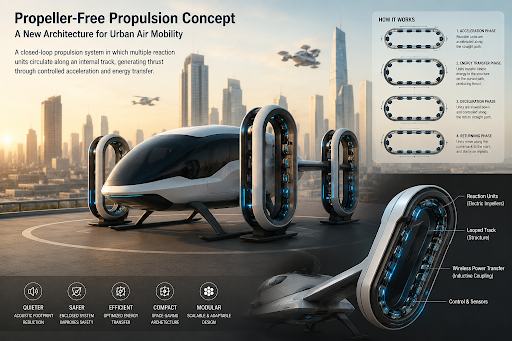
An alternative propulsion concept developed by Iranian-German mechanical engineer and inventor Mohsen Bahmani (graduated from KIT University) proposes a substantially different architectural approach.
Protected under European patent EP3565971B8, the concept eliminates externally mounted propellers and instead organizes multiple propulsion units within an internal looped structure.
Rather than relying on isolated rotating blades, the propulsion mechanism operates through coordinated phases of acceleration, force transfer, deceleration, and recirculation across an enclosed system.
This approach reframes propulsion as an integrated mechanical architecture rather than a collection of independent thrust-generating components.
Technical documentation associated with the design emphasizes that the system remains reaction-based and aligned with Newtonian mechanics, rather than proposing reactionless propulsion or physically unverified mechanisms.
The architecture also integrates wireless power transfer technology intended to reduce wear associated with conventional electrical contact systems.
Supporters suggest that enclosed propulsion systems of this kind may offer potential advantages in operational safety, compact structural integration, and acoustic management—all areas of significant importance in urban aviation.
Why Urban Air Mobility May Need Architectural Innovation
The central question is not whether unconventional propulsion systems are technically interesting, but whether the urban air mobility market requires a different engineering framework.
In many respects, current market conditions suggest that it might.
Urban aircraft face a difficult design contradiction. They must generate sufficient lift for vertical operation while remaining compact, safe, efficient, and socially acceptable in highly populated environments.
Traditional aviation was optimized for open airspace, airports, and large operational buffers—not rooftop vertiports and dense city infrastructure.
This creates a meaningful design gap.
Enclosed propulsion architectures could theoretically reduce hazards associated with exposed rotating systems, improve integration into compact vehicle bodies, and offer greater flexibility in future aircraft design.
Noise reduction alone represents a potentially decisive factor. Even moderate improvements in acoustic performance could materially improve both regulatory acceptance and public adoption.
While many established eVTOL developers continue refining rotor-based systems, most remain focused on optimizing existing frameworks rather than pursuing architectural reinvention.
This leaves conceptual room for alternative propulsion approaches capable of addressing unresolved structural constraints.
Engineering Challenges Remain Significant
Conceptual differentiation alone does not guarantee commercial viability.
Alternative propulsion systems must compete against technologies that are not merely established, but highly optimized after decades of engineering refinement.
Several technical questions remain critical for any enclosed propeller-free system.
Control complexity is one major consideration. Coordinating multiple moving propulsion elements within a synchronized closed-loop architecture requires highly precise control logic, dynamic stability management, and robust fault tolerance.
Thermal management is another challenge. Enclosed propulsion systems may concentrate heat more aggressively than external architectures, potentially complicating cooling strategies.
Wireless power transfer, while mechanically elegant, introduces efficiency considerations under continuous dynamic load conditions.
Even small energy losses can become commercially significant in aviation, where efficiency directly influences operational range and economics.
Scalability remains perhaps the most important unknown.
A propulsion concept that functions effectively at smaller scales or in controlled environments may face entirely different engineering realities when scaled for passenger aircraft applications requiring repetitive, high-reliability performance.
These considerations do not invalidate alternative architectures, but they do position them as exploratory engineering pathways rather than immediate market-ready solutions.
A Sector Still Searching for the Right Answer
Urban air mobility continues to face unresolved propulsion-related constraints.
Noise remains a public concern. Safety remains an engineering limitation. Operational economics remain uncertain. Regulatory pathways remain complex.
These challenges suggest that the industry may benefit from broader experimentation beyond incremental rotor optimization.
Mohsen Bahmani’s propeller-free propulsion concept enters this discussion not as a proven replacement for conventional systems, but as a challenge to long-standing assumptions in aircraft design.
Its broader relevance lies in expanding the engineering conversation around how thrust generation may evolve in future urban aircraft.
Whether enclosed propulsion architectures ultimately influence mainstream urban aviation will depend on testing, validation, manufacturability, certification feasibility, and operational performance.
But in an industry still searching for the optimal balance between efficiency, safety, noise reduction, and urban integration, unconventional propulsion ideas may represent an important part of the next phase of innovation.