



For more than a decade, BlackRock’s Aladdin platform has represented the gold standard of institutional financial infrastructure. Used by some of the largest asset managers and financial institutions in the world, Aladdin became synonymous with large-scale portfolio analytics, risk management, and market oversight.

But financial AI is evolving.
As markets become faster, more adaptive, and increasingly autonomous, a new generation of systems is beginning to emerge — systems designed not just to analyze markets, but to continuously learn from changing market conditions.
Otonomii is an autonomous market intelligence system developed under the direction of Kaushal Sheth, a veteran banking infrastructure architect and current CTO USA at GFT Technologies.
Unlike traditional financial AI systems that rely heavily on historical prediction models, Otonomii’s architecture is built around continuous observation, regime awareness, governed autonomy, and real-time adaptation to changing market conditions.
Those differences become more visible when comparing the actual architectural capabilities modern financial AI systems do — and do not — possess.
From Banking Infrastructure to Autonomous Systems
Kaushal Sheth’s background gives unusual weight to the discussion.
Long before Otonomii, Sheth spent decades building banking and enterprise financial systems. He co-founded Sophos Solutions, a Latin America-based financial technology firm focused on the modernization of large financial institutions across North and South America.
In 2024, Sophos Solutions was acquired by GFT Technologies in an approximately EUR 87 million transaction. According to Quirin Privatbank’s analyst report on the acquisition, Sophos specialized in “the digital transformation of large financial institutions in North and South America,” employed more than 1,700 people, and maintained customer relationships across more than 10 countries.
Today, Sheth serves as CTO USA at GFT Technologies, a global financial technology company operating in banking infrastructure and enterprise systems delivery for major financial institutions.
That progression matters because Otonomii did not emerge from retail trading culture or generic AI experimentation. It emerged from institutional banking infrastructure.
Comparing The Systems
The differences become clearer when comparing how each platform approaches financial intelligence, adaptation, governance, and autonomous behavior.
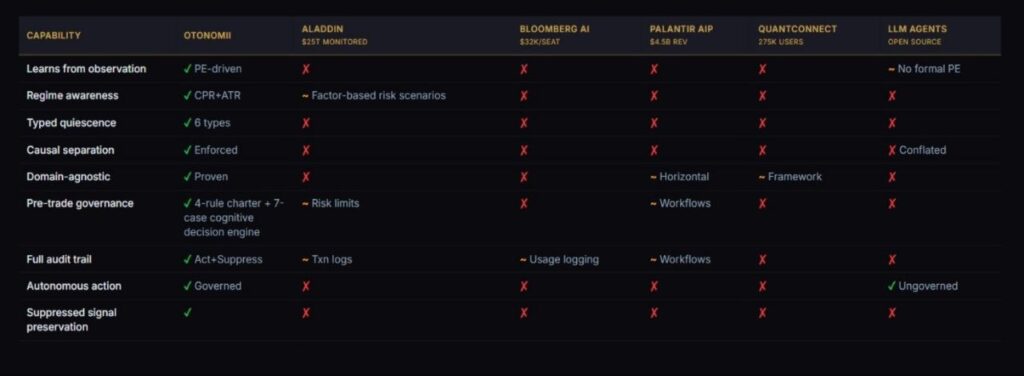
Aladdin
Aladdin remains one of the most sophisticated institutional portfolio and risk management systems ever built. Its strengths lie in centralized oversight, analytics, portfolio monitoring, and institutional-scale workflow infrastructure.
However, Aladdin was fundamentally designed around analytics, orchestration, and portfolio visibility rather than autonomous cognition or continuously adaptive market learning.
Bloomberg AI
Bloomberg’s AI capabilities are highly effective in financial data aggregation, research acceleration, terminal intelligence, and information delivery. Bloomberg excels at helping analysts process and access information faster.
But its architecture remains information-centric rather than behaviorally adaptive. Bloomberg primarily delivers intelligence to users rather than operating as a continuously learning autonomous market system itself.
Palantir AIP
Palantir’s AI infrastructure focuses heavily on enterprise orchestration, workflow integration, and large-scale operational intelligence. Its strength comes from connecting enterprise systems and enabling AI-assisted operations.
However, Palantir was not specifically designed for adaptive financial cognition inside live market environments. Its architecture is broader and more horizontal across industries rather than purpose-built for financial market intelligence.
Large Language Model Agents
Generic LLM agents introduced major advances in language reasoning and conversational AI interaction, but they also exposed important limitations inside finance.
Large language models can summarize, reason, and interact conversationally, but most lack structured market memory, regime awareness, governed execution frameworks, and causal separation between learning and execution behavior.
Those limitations become particularly important during unstable or rapidly shifting market conditions.
Otonomii
Otonomii’s architecture appears built around a different objective entirely: continuous market adaptation.
Its framework includes regime awareness, causal separation, governed autonomy, typed quiescence, and suppressed signal preservation — capabilities rarely associated with traditional financial AI infrastructure.
Rather than operating primarily as an analytics layer or workflow platform, Otonomii appears designed to continuously observe changing market conditions, dynamically adapt behavior, preserve rejected decisions for future learning, and operate inside predefined governance structures.
That may represent one of the larger architectural shifts currently emerging inside financial AI infrastructure.