



The UAE has spent the last five years transforming itself from a relatively light-touch corporate environment into one of the most carefully structured business jurisdictions in the region. Federal corporate tax. VAT obligations. Economic substance rules. Updated mainland licensing frameworks. New free zone activity codes. The list keeps growing.
For founders, investors, and international companies looking at the UAE in 2026, the basics of business setup still look similar to what they did a decade ago. Pick a structure. Choose an activity. Get a license. Open a bank account. Start operating. But the choices inside each of those steps now carry consequences that most first-time entrants don’t fully appreciate until they’re already operating.
This article breaks down what business setup in the UAE actually involves today, where the common mistakes happen, and how to think about the structural decisions that affect everything from your tax exposure to your ability to do business with local UAE clients.
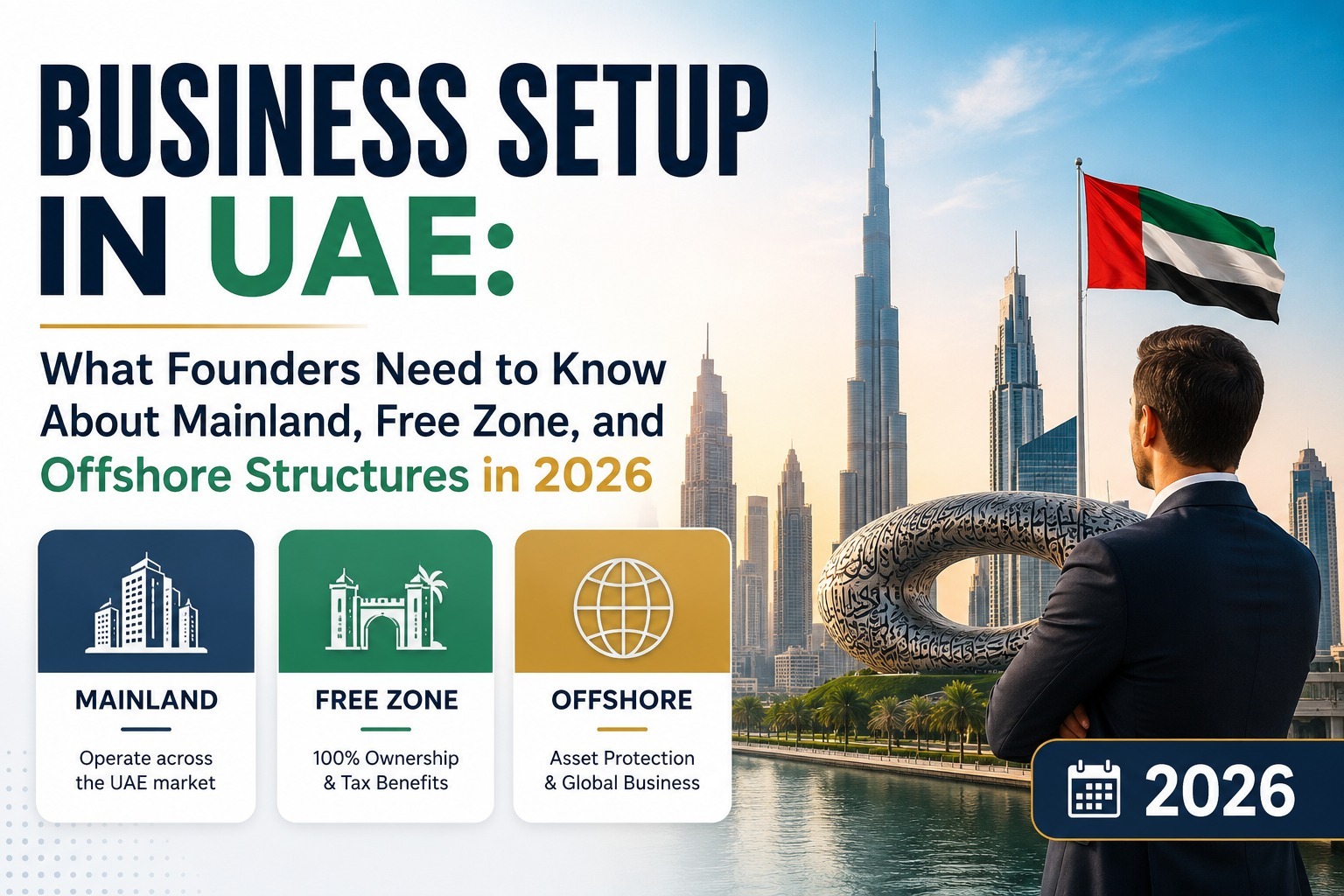
The Three Primary Structures: Mainland, Free Zone, Offshore
Almost every business setup conversation in the UAE starts with one decision. Which jurisdiction does your company sit in? There are three primary options, each built for different business models.
Mainland Companies
A mainland company is licensed by the Department of Economy and Tourism (in Dubai) or the equivalent emirate-level authority. These companies can trade directly with the broader UAE market, take government contracts, and operate retail or service businesses anywhere in the country without restriction.
The 2021 change that allowed 100% foreign ownership in most activities removed what was historically the biggest barrier to mainland setup. Today, a foreign founder can fully own a mainland LLC across most business activities, with no requirement for a local partner.
Mainland is the right choice if your business model depends on serving UAE customers directly, opening retail or physical service locations, or pursuing contracts with government entities. It’s typically not the most efficient option for purely international service businesses that don’t need a UAE customer base.
Free Zone Companies
Free zones are designated economic areas with their own licensing authorities, infrastructure, and tax incentives. There are more than 45 free zones across the UAE, each with its own activity focus and benefits.
Free zone companies typically offer 100% foreign ownership, 0% corporate tax on qualifying income (for entities that meet the qualifying free zone person criteria under federal corporate tax rules), simplified setup processes, and full repatriation of capital and profits.
The trade-off is that free zone companies generally cannot trade directly with the mainland UAE market without engaging a local distributor or establishing a separate mainland presence. For international consulting firms, e-commerce businesses, holding companies, and tech operations that don’t need direct UAE retail access, free zones often deliver the best combination of cost, compliance, and tax efficiency.
Offshore Companies
Offshore companies in the UAE (most commonly registered in jurisdictions like RAK ICC or JAFZA Offshore) are structured for international business activities, holding company purposes, and asset protection. They typically cannot operate physical businesses in the UAE itself, but they offer privacy, structural flexibility, and a low-cost framework for international structuring.
Offshore is not a way to avoid UAE compliance. It’s a way to structure international holdings, intellectual property, or investment activities through a UAE-registered entity for legitimate business reasons. Setting up an offshore company without a clear business purpose creates regulatory risk that outweighs the structural benefits.
What Corporate Tax and VAT Actually Mean for New UAE Businesses
The biggest shift in UAE business setup in the past three years is the introduction of federal corporate tax. Effective for financial years starting on or after 1 June 2023, the UAE applies a 9% corporate tax on taxable income above AED 375,000, with 0% on income up to that threshold.
Qualifying free zone persons can continue to benefit from a 0% rate on qualifying income, but the rules around what counts as qualifying income are stricter than many founders realize. Mainland companies and free zone companies with non-qualifying income are both subject to the standard 9% rate.
VAT, introduced in 2018, applies a 5% rate on most goods and services. Businesses with taxable supplies exceeding AED 375,000 annually must register for VAT. Many new businesses don’t realize they need to register until they’re already in violation, which triggers penalties that easily exceed what proper setup would have cost.
The key insight for new founders: the tax structure of your UAE entity is now a meaningful part of the setup decision, not an afterthought to handle later. Choosing the wrong structure for your business model can permanently affect your tax exposure.
Common Mistakes Founders Make in UAE Business Setup
A few patterns come up repeatedly with first-time UAE business setups.
Choosing a free zone based on price alone. The cheapest free zone is not always the right one. Each free zone has approved activity lists, banking relationships, and ecosystem advantages that matter once you’re operating. Saving AED 5,000 on setup can cost AED 50,000 later when you discover your activity isn’t fully covered or your free zone doesn’t have the banking partnerships you need.
Underestimating the banking process. UAE bank account opening for new companies has become significantly more demanding since 2021. Banks now conduct detailed KYC reviews, source-of-funds documentation, and business activity verification before approving accounts. A poorly prepared application can stall a business for months. Plan for this in advance, not after the license is issued.
Misunderstanding economic substance rules. Many companies, particularly those in finance, holding, IP, headquarters, distribution, service center, leasing, and shipping activities, must meet Economic Substance Regulations. Failure to comply triggers reporting obligations and potential penalties.
Skipping professional advisory. UAE business setup has enough moving parts that DIY approaches frequently produce structures that work technically but create unnecessary tax, compliance, or operational friction later. Professional advisory before incorporation is significantly cheaper than restructuring afterward.
For founders working through these decisions, ITA Business Consultants Business Setup in UAE provides advisory-led support specifically focused on the structural and compliance decisions that shape a UAE company’s long-term operating environment. Their approach emphasizes understanding obligations and decision points before incorporation rather than after.
A Practical Framework for Approaching UAE Business Setup
Rather than starting with “which free zone is cheapest” or “should I go mainland,” the more useful starting point is your business model. Three questions clarify most setup decisions.
Who are your customers? If they’re primarily in the UAE and you need physical or contractual access to the local market, mainland is usually the right answer. If they’re international, free zone is typically more efficient. If you’re holding assets rather than operating a business, offshore may be appropriate.
What is your taxable income likely to be? Below AED 375,000 in annual taxable income, the corporate tax rate is 0% regardless of structure. Above that threshold, the choice between qualifying free zone status and standard mainland taxation becomes financially significant.
What is your operational footprint? Companies needing UAE employees, physical office space, and retail presence have different requirements from purely digital or international businesses. The structure should match the operational reality, not the other way around.
The Bottom Line
UAE business setup in 2026 is more accessible than ever, but also more structured. The country has built a sophisticated regulatory environment that rewards founders who plan their setup carefully and penalizes those who treat it as a checkbox exercise.
The right structure for your business depends on customer base, expected income, operational footprint, and long-term plans. Getting that decision right at the start is significantly cheaper than fixing it later. For most founders, that means doing real research, talking to qualified advisors, and treating the setup phase as a strategic decision rather than a procedural step.
The UAE remains one of the most attractive global jurisdictions for international business. Walking in with realistic expectations and a clear structural plan is what separates the founders who thrive here from the ones who spend their first year unwinding avoidable problems.