



At a June 16 event in California, the company unveiled a robotics ecosystem built around humanoids, robot dogs, developer tools, and what it believes could become the next computing platform.
For the past three years, the AI conversation has largely revolved around language models.
Bigger models. Better reasoning. Faster inference.
But if the next phase of artificial intelligence moves beyond screens and into the physical world, companies will need more than chat interfaces. They’ll need robots that can perceive environments, understand context, and take action.
That’s the future Faraday Future is betting on.
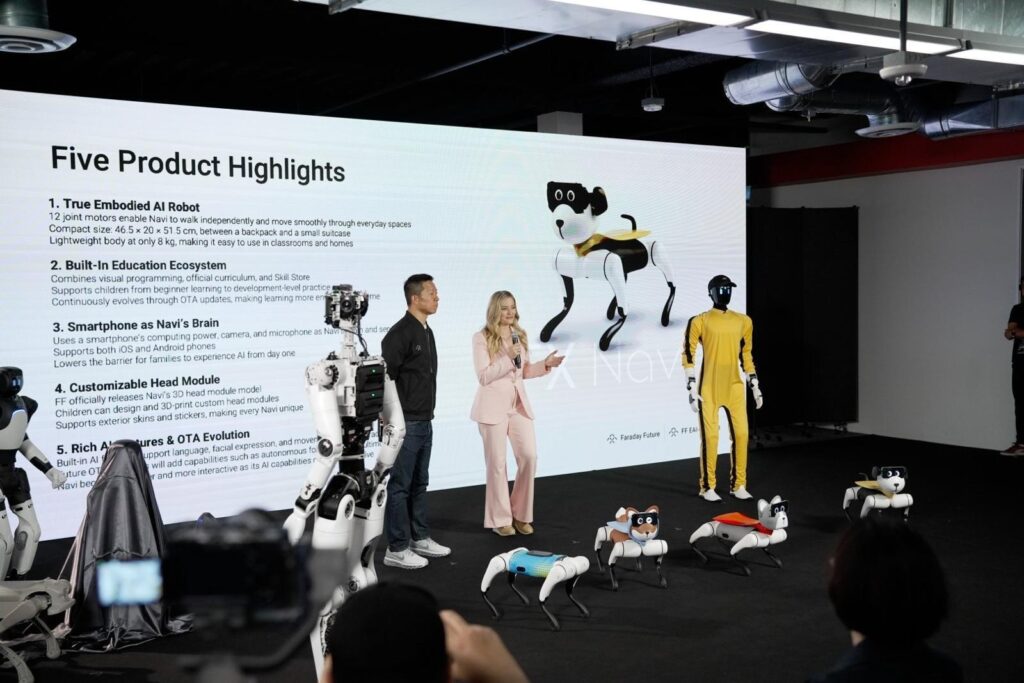
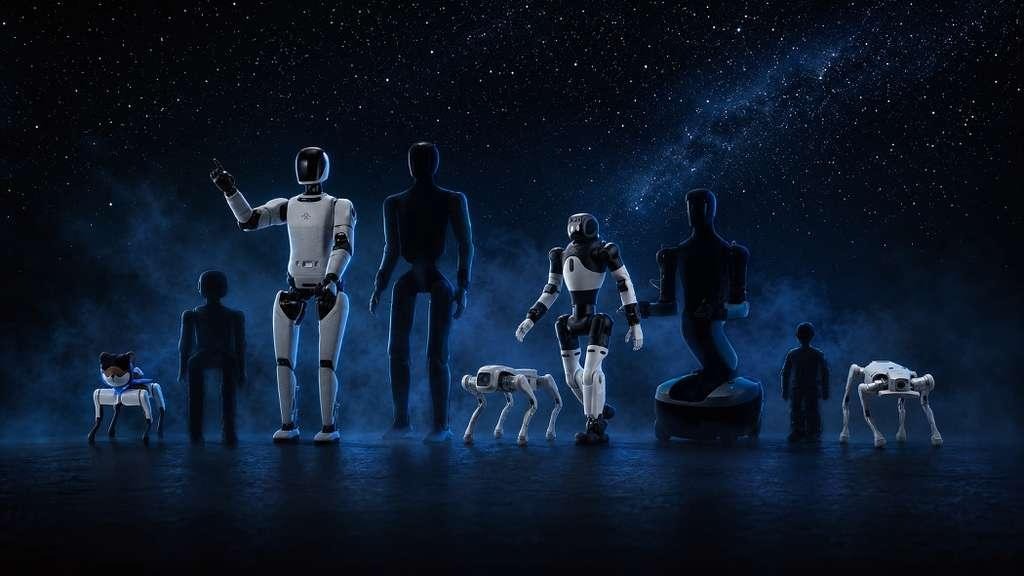
On June 16, 2026, at its headquarters in El Segundo, California, the company unveiled what it calls its Full-Form EAI Robot World, a robotics ecosystem spanning six product categories, a new education platform, open-source developer tools, humanoid robots, and a consumer-focused quadruped robot called FX Navi.
The event marks one of the most ambitious attempts yet to create a consumer-facing ecosystem around what the company calls Embodied AI (EAI)—AI that doesn’t simply generate answers but exists in the physical world through machines capable of movement, perception, and interaction.
Most robotics companies are currently focused on a single form factor.
Tesla is pursuing humanoids. Unitree is pursuing humanoids and quadrupeds. Figure AI is focused on industrial humanoids.
Faraday Future is taking a different approach.
The company’s strategy is built around what it calls “one brain, multiple forms.” Instead of developing a single robot, it is creating a shared AI architecture that can power multiple physical embodiments.
In practical terms, that means everything from educational robot dogs to full-sized humanoids could eventually operate on the same underlying intelligence layer.
The flagship example unveiled during the event was the All-New Futurist, a humanoid robot designed for commercial, industrial, and public-facing applications. The robot stands approximately 5 feet 8 inches tall, weighs about 121 pounds, features 31 degrees of freedom, and can run at speeds approaching 11 miles per hour. It also incorporates NVIDIA Sonic full-body motion control technology and is expected to receive an Ultra version later this year powered by NVIDIA’s Jetson Thor platform.
The technical specs are impressive.
But the more interesting announcement may have been the software stack beneath them.
Faraday Future is building around a combination of Vision-Language-Action (VLA) models and World Models—two of the most important concepts currently emerging in robotics research.
Large language models excel at understanding text. VLA systems attempt to connect perception, reasoning, and action. A robot doesn’t simply interpret a command—it understands what it sees, predicts outcomes, and physically executes tasks.
World models add another layer by allowing systems to simulate and anticipate how environments might behave before taking action.
In theory, this enables robots to become significantly more adaptable outside controlled laboratory conditions.
The company’s most consumer-friendly product is FX Navi, a quadruped robot aimed at homes and classrooms.
Priced at $1,990, Navi is designed as an entry point into robotics development and AI education. The robot includes 12 joint motors, visual programming tools, curriculum support, and a modular architecture that allows children to customize and even 3D-print components. A smartphone serves as the robot’s primary computing platform, lowering hardware costs while leveraging the increasingly powerful processors already sitting in people’s pockets.
That educational angle is central to the broader strategy.
Faraday Future simultaneously launched what it describes as the world’s first Three-in-One EAI Robotics Education Ecosystem, combining hardware, curriculum, and developer tools into a unified platform designed for both institutions and families.
Alongside the robots, the company introduced an open developer ecosystem featuring tools like Brain Blocks, EAI Soul, Create Studio Beta, and SDK/API access. Developers ranging from elementary school students to professional engineers can build, test, and deploy applications across multiple robot types.
The strategy reflects a growing belief throughout the AI industry that the next major platform may not be a phone, laptop, or chatbot.
It may be a physical machine.
Whether Faraday Future ultimately succeeds in building that ecosystem is still an open question. The robotics field remains fiercely competitive and technically challenging.
But one thing became clear during the June 16 launch:
The company is no longer thinking only about the future of transportation.
It’s thinking about the future of physical intelligence itself.