




When a business owner dies holding an interest in a closely held company, that ownership stake becomes part of the taxable estate, and its value has to be established through a formal appraisal, not a guess. The IRS accepts three general approaches (asset-based, income-based, and market-based) applied by a qualified, independent appraiser using accepted valuation standards. Getting this number right the first time avoids penalties, delays, and disputes with the IRS later.
What Triggers a Business Valuation for an Estate?
A business valuation becomes necessary any time a deceased person’s estate includes an ownership interest in a privately held company, partnership, farm, or professional practice. Because there is no public market price to reference, the fair market value has to be reconstructed from financial records, industry data, and comparable transactions. This applies regardless of whether the estate ultimately owes tax.
Common triggers include:
● Sole or partial ownership of a family business, LLC, or S-corporation at the time of death
● Ownership of a farm, ranch, or agricultural operation with land and equipment
● Interests in a professional practice such as a medical, dental, legal, or accounting firm
● Minority or fractional interests in a partnership that lack a ready market
● Estates approaching or exceeding the federal estate tax exemption threshold, which requires a Form 706 filing with the IRS
Which Valuation Methods Do Appraisers Use?
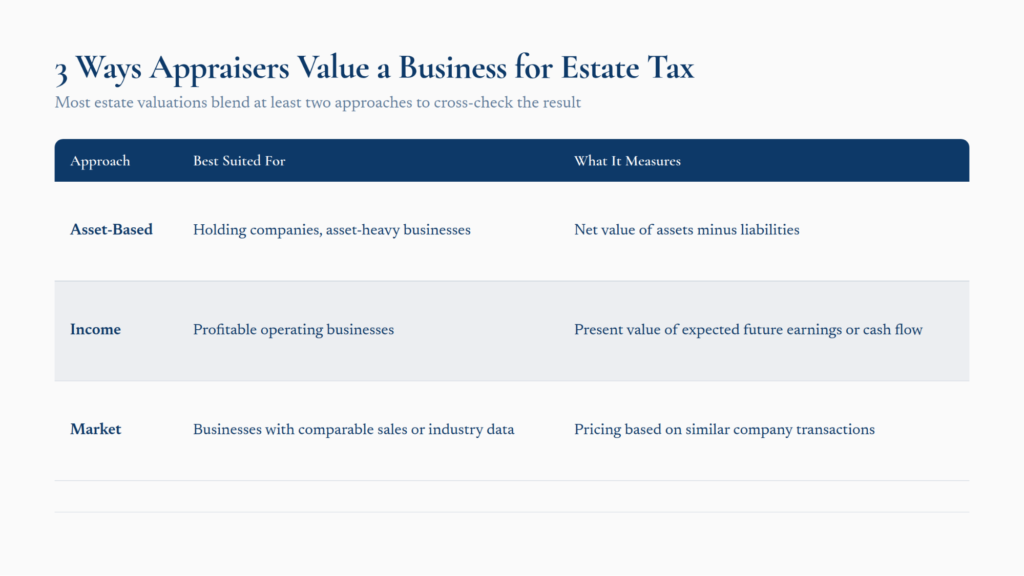
Appraisers typically rely on one or a blend of three recognized approaches: the asset-based approach, the income approach, and the market approach. The choice depends on whether the business is asset-heavy, cash-flow driven, or has comparable sales data available. Most estate valuations combine at least two methods to cross-check the result.
| Approach | Best suited for | What it measures |
| Asset-based | Holding companies, asset-heavy businesses | Net value of assets minus liabilities |
| Income approach | Profitable operating businesses | Present value of expected future earnings or cash flow |
| Market approach | Businesses with comparable sales or industry data | Pricing based on similar company transactions |
What Documents Does the Appraiser Need?
A thorough estate valuation depends on complete financial and legal records covering several years of the company’s history. Missing documentation is one of the most common reasons an appraisal takes longer than expected or draws IRS scrutiny. Executors should start gathering paperwork as soon as possible after death.
Documents typically requested include:
● Three to five years of federal business tax returns and financial statements
● Operating agreements, bylaws, or partnership agreements
● A capitalization table or ownership ledger showing all interests
● Buy-sell agreements, since these can affect fair market value
● Prior appraisals, if any exist, for comparison purposes
Families handling a complex estate often work with a firm such as Equity Business Valuation Services to compile these records and produce a defensible report that satisfies both the executor’s attorney and the IRS.
How Does the IRS Review Estate Tax Valuations?
The IRS reviews estate tax valuations submitted with Form 706 and can challenge figures it considers unsupported or inconsistent with the underlying financials. Estates are generally required to obtain a qualified appraisal when the value of an included business interest is significant enough to affect the tax due. Appraisers who prepare these reports typically follow recognized professional standards so the conclusions hold up under review by the Internal Revenue Service.
Because valuation disputes can lead to penalties, interest, and prolonged audits, many estates rely on credentialed appraisers affiliated with organizations such as the American Society of Appraisers or the National Association of Certified Valuators and Analysts, both of which set methodology and ethics standards for business valuation professionals.
Common Mistakes That Trigger IRS Challenges
Most valuation disputes trace back to a handful of avoidable errors rather than genuine disagreements over methodology. Recognizing these early can save an estate significant time and expense.
Frequent mistakes include:
● Using a valuation date that does not match the actual date of death or alternate valuation date
● Applying discounts for lack of marketability or control without adequate support
● Relying on outdated financial statements that do not reflect the company’s condition near the date of death
● Skipping a formal appraisal in favor of a rough estimate from an accountant or family member
● Failing to document the reasoning behind the chosen valuation method