
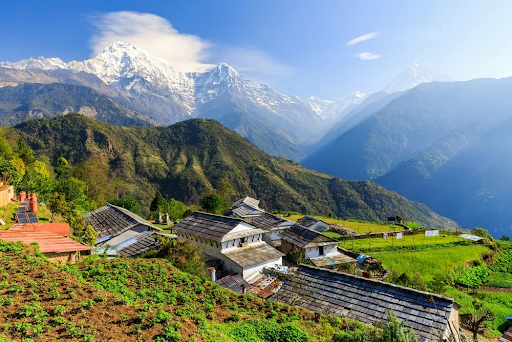
Nepal doesn’t look like anywhere else on earth. In the span of a single shoot day, you can move from subtropical jungle floor to the edge of a glacier. You can frame a centuries-old Hindu shrine against a backdrop of Himalayan peaks. You can capture a medieval courtyard that hasn’t changed much since the 14th century, then drive an hour and find yourself in a chaotic, colour-drenched city market that looks like nothing a set designer could replicate.
That visual range is exactly why international film crews keep returning. Feature films, documentary series, travel content, commercials, branded films. Nepal delivers images that audiences remember.
But Nepal also has its own pace, its own bureaucracy, its own weather, and its own way of doing things. International productions that arrive underprepared often lose days, sometimes weeks, to permit problems, customs delays, or logistical misjudgements that local experience would have caught early. This guide covers what you actually need to know before your crew lands.
Start With Location Research, Not a Google Maps Screenshot
The instinct for most international producers is to find reference images online, mark a few pins on a map, and start building a schedule. In Nepal, that approach falls apart quickly.
The country offers genuinely diverse filming environments:
- Himalayan mountain terrain, from accessible viewpoints to remote high-altitude routes
- UNESCO World Heritage Sites including Pashupatinath, Swayambhunath, the Kathmandu Durbar Squares, Lumbini, Chitwan, and Sagarmatha
- Living heritage towns such as Bhaktapur, Patan, Bandipur, and Tansen
- National parks and wildlife zones including Chitwan, Bardia, Langtang, and Sagarmatha
- Rivers, gorges, and waterfalls including the Seti River, Marshyangdi, and Kali Gandaki
- Remote hill villages accessible only on foot or by small aircraft
- Modern Kathmandu and Pokhara with urban texture very different from Western cities
What the map won’t show you: that a location 80 km from Kathmandu might be a four-hour drive on mountain roads. Or that a particular viewpoint requires a two-day trek and acclimatisation time before your director of photography can safely operate at altitude. Or that a heritage courtyard that looks perfectly accessible in photos is actually locked at certain hours, or requires special temple authority clearance.
Professional location scouting during pre-production is one of the highest-value investments you can make. It eliminates surprises and builds the realistic schedule your production actually needs, not the optimistic one you wrote from a hotel in London or Los Angeles.
Filming Permits: Understand the System Before You Arrive
Nepal requires government approval for professional commercial filming. This isn’t just a formality. It’s a real process with real consequences if you skip it.
The permits you’ll need depend on several factors:
- The nature of your production (documentary, commercial, feature film, news)
- Where you are shooting (Kathmandu valley, national parks, conservation areas, restricted regions)
- What equipment you are bringing in, especially drones and broadcast cameras
- Your crew composition, as foreign crew members may require additional documentation
Productions filming inside national parks, UNESCO heritage zones, or restricted border areas need clearances from multiple government bodies, not just one central permit. The Department of Information and Broadcasting, the Department of National Parks, the Civil Aviation Authority, and individual site-managing trusts or municipalities all have jurisdiction over different locations. Each has its own timeline and process.
The key point: permit processing takes time, and that timeline is not always predictable. Productions that start the paperwork eight to ten weeks before their shoot date are in a much stronger position than those who try to sort it out on arrival or in the final two weeks before cameras roll.
For a clear breakdown of what’s required and how to approach the process, see the Film Permits in Nepal page, which covers the specifics by production type and location category.
Drone Filming Requires Separate Aviation Clearance
Drones get their own section because the number of productions that arrive with drones and no drone-specific permits is surprisingly high, and it causes serious problems.
Nepal’s Civil Aviation Authority (CAAN) governs all UAV operations. The rules include:
- Registration of drone equipment before flights
- No-fly zones around airports, military installations, and many heritage sites
- Altitude restrictions in certain regions
- A separate application process from standard film permits
The Kathmandu valley has particularly strict drone regulations because of active air traffic and the density of heritage sites. Productions planning aerial footage in and around the valley need to plan well ahead and in some cases may need to adjust creative expectations based on what is actually permitted.
Productions that try to fly drones without clearance risk equipment confiscation, fines, and in some cases, jeopardising the rest of the shoot.
The Fixer Is Not Optional
Many international producers treat a local fixer as a nice-to-have, someone to help with translation or arrange a driver. In Nepal, that is a fundamental misunderstanding of the role.
A skilled Fixer in Nepal is effectively your local production infrastructure. They are the person who knows which government official handles which permit category, which road is impassable after rain, which temple priests will cooperate with a foreign crew and which won’t, which local vendors are reliable, and how to solve problems before they become shoot-day emergencies.
A good fixer manages:
- Government communication and permit coordination, navigating the system on your behalf, in Nepali, with existing relationships
- Location access, gaining entry to locations not straightforwardly accessible to foreign crews
- Local crew hiring, identifying experienced local DOPs, ACs, gaffers, sound recordists, production assistants, and drivers
- Transport logistics, organising vehicles for mountain roads, booking domestic flights before they fill up, coordinating gear transport to remote locations
- Cultural translation, not just language but reading situations correctly so your crew does not inadvertently cause offence or lose access
- Scheduling reality-checking, catching the overambitious schedule before it becomes a shoot-day disaster
- Accommodation and catering, sourcing appropriate options at each location, which matters enormously in areas outside Kathmandu and Pokhara
The quality of your fixer directly determines how much of your creative vision actually makes it on screen. This is the one hire you should not cut corners on.
Working With a Local Production Company
For larger productions such as features, broadcast series, and major commercials, the most efficient structure is to engage a full-service Film Production Company in Nepal rather than trying to assemble individual vendors independently.
A production company with genuine international experience handles end-to-end line production: budgeting, permitting, staffing, transport, location management, equipment sourcing, post-production coordination, and project management throughout. You communicate with one team that holds everything together, rather than managing ten separate vendor relationships across a language barrier.
This structure also gives you cleaner accountability. When a vendor doesn’t deliver or a permit hits a snag, you have a production partner whose job is to fix it, not a list of individual contractors pointing at each other.
For international producers visiting Nepal for the first time, the production company relationship is also an education. You learn how things actually work here, which pays dividends on any future productions in the country.
Nepal’s Geography Is an Asset and a Challenge
The country’s visual diversity is a genuine production advantage. The challenge is that the same terrain that creates spectacular images also makes logistics complicated.
A few things that catch international productions off guard:
Drive times are long and unreliable. Pokhara to Jomsom looks manageable on a map. The road tells a different story. Mountain highways are single-lane in places, subject to landslides during monsoon, and sometimes blocked entirely by weather or construction. Productions that build a schedule based on straight-line map distances miss this entirely.
Domestic flights are limited and weather-dependent. Several key filming locations, including Lukla (Everest region), Jomsom (Mustang), Dolpo, and Humla, are only accessible by small aircraft. These flights operate on narrow weather windows, have limited daily capacity, and are routinely delayed or cancelled. Building contingency days around domestic flight connections is not pessimism. It is basic production planning.
Altitude affects your crew. Anything above 3,500 metres requires acclimatisation time, and above 4,000 metres, altitude sickness becomes a genuine risk for crew members who have ascended too fast. Productions that schedule mountain shoots without factoring in acclimatisation days are putting crew health at risk and often lose shoot days anyway because someone is incapacitated.
Weather creates entirely different images. Post-monsoon October and November gives you the clearest mountain views and the most stable weather. Spring (March to May) brings rhododendron colour and good visibility. Monsoon season (June to September) brings dramatic rain, lush green landscapes, and frequent disruptions. Winter closes some high passes. Matching your season to your creative requirements is a real decision, not an afterthought.
Equipment and Customs
Productions arriving with substantial equipment loads, including multiple camera bodies, cine lenses, lighting rigs, sound packages, and drone systems, need to approach customs as a pre-production task, not an arrival-day surprise.
Prepare a detailed, itemised equipment manifest before you travel. Customs procedures for temporary import of professional production equipment in Nepal can be smoothed considerably with the right documentation and, ideally, advance coordination through your local production partner. Trying to explain a Pelican case full of broadcast lenses to customs without paperwork wastes time and creates risk of equipment being held.
Drone equipment needs its own documentation layer separate from the general equipment manifest.
If you are renting equipment locally, Kathmandu has a growing professional equipment rental market. Quality has improved significantly over the past decade. A good local production partner can advise on what is worth renting locally versus bringing from overseas.
Cultural Respect Is Both the Right Thing and Good Production Practice
Nepal is a deeply religious country. Hinduism and Buddhism are not background aesthetics. They are living traditions that shape daily life. The temples, shrines, and monasteries that make such compelling film locations are active places of worship, not set dressing.
Specific things international crews need to understand:
Photography and filming restrictions exist at many sacred sites. Some inner sanctums are completely off limits to cameras. Some sites prohibit filming of specific rituals. Ignoring these restrictions, or trying to shoot quietly without permission, can result in being removed from the location, losing access entirely, and damaging the reputation of future productions.
Permission for religious ceremonies must be obtained in advance. Arriving at a festival or ceremony with a camera and expecting to film is not how it works. The relevant temple trusts, local authorities, or community leaders need to grant access, usually arranged through your local production team.
Dress codes apply. Many heritage sites require covered shoulders and knees. Sending your crew in shorts and sleeveless tops to a temple location is an avoidable problem.
The communities around your filming locations matter. Productions that treat local communities with respect, compensate fairly when appropriate, and leave locations as they found them build goodwill that makes filming easier and reflects well on the productions that come after them.
Safety Planning Starts in Pre-Production
Nepal’s most spectacular locations are often its most remote. The combination of altitude, mountain terrain, unpredictable weather, and limited emergency infrastructure means safety planning needs serious attention.
A production safety plan for Nepal should include:
- Emergency communication, including satellite phones or radio for locations without mobile coverage
- Medical contingency, including first aid kits rated for altitude environments and a protocol for evacuation if needed
- Insurance appropriate for high-altitude and remote location work
- Local guides for trekking routes and unfamiliar mountain terrain
- Weather monitoring, particularly for mountain and aerial operations
- Altitude protocols, including ascent schedules, symptom awareness, and crew fitness assessments for high-altitude shoots
- Documented risk assessments shared with the full crew before departure for remote locations
Helicopter evacuation is available in Nepal but expensive and weather-dependent. The goal is to plan so thoroughly that you never need it.
Build a Schedule That Reflects Reality
The single most common production planning mistake in Nepal is an overambitious schedule.
Productions that have worked in other international locations sometimes arrive with a framework built on assumptions that you can move quickly between locations, that permits will come through on a standard timeline, that weather will cooperate, that a location that looked perfect in a reference photo will be available on the day you need it.
Nepal requires buffer. Because nothing works here, but because the terrain, the permitting system, and the climate all introduce genuine variability that you cannot optimise away. Contingency days in your production calendar are not wasted days. They are the insurance that lets you capture your best shots rather than scrambling to cover what you missed because your original plan was too tight.
Productions that come with realistic schedules, strong local partnerships, and appropriate contingency plans tend to leave with footage that makes the investment worthwhile. Those that don’t usually leave wishing they had done more pre-production.
Final Thoughts
Nepal is extraordinary filming territory. It earns that reputation. But it rewards the productions that approach it seriously, with genuine pre-production investment, experienced local partners, an understanding of the permit landscape, and respect for the country’s culture and environment.
The productions that do that work come back with images that couldn’t have been made anywhere else. The ones that wing it come back with expensive lessons.
If you are planning an international shoot here, start the conversations early. With permit specialists, with a local production company, and with anyone who has actually made something here. The preparation is where successful Nepal productions are built.