



AI detection tools have become increasingly common in education, publishing, and the workplace. Universities use them to review assignments, businesses use them to evaluate marketing content, and editors rely on them as part of their review process.
Despite their growing popularity, one misconception continues to cause confusion: many people believe that if a detector labels a piece of writing as AI-generated, then it must have been written by artificial intelligence.
In reality, that’s not how AI detectors work. They estimate the likelihood that a piece of text resembles patterns commonly found in AI-generated writing. Because of this, even completely human-written content can sometimes receive a high AI score.
Understanding why this happens helps writers interpret detection results more accurately and avoid unnecessary concerns.
AI Detectors Don’t Know Who Wrote the Text
Perhaps the most important thing to understand is that AI detectors cannot determine authorship.
Unlike plagiarism checkers, which compare submitted work against existing documents, AI detectors analyze writing style. They look for statistical characteristics that are more common in machine-generated content than in typical human writing.
These characteristics may include:
- sentence predictability;
- vocabulary distribution;
- repetition of structure;
- consistency of grammar;
- overall language complexity.
Based on these signals, the detector produces a probability score, not proof.
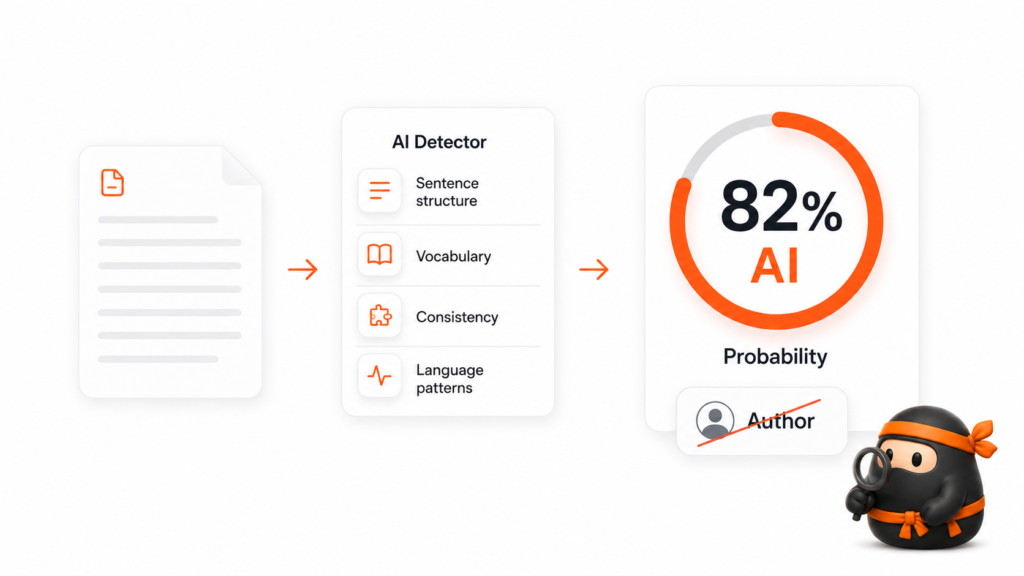
This means that a high AI score does not necessarily indicate that artificial intelligence created the document.
Human Writing Can Naturally Resemble AI
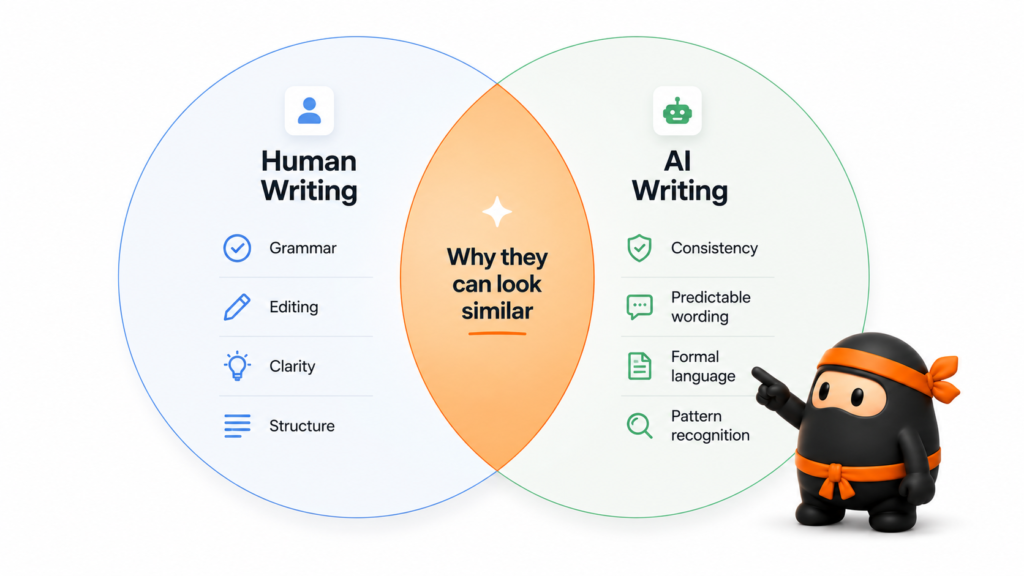
Some people naturally write in a style that overlaps with the patterns AI detectors look for.
For example, experienced technical writers, researchers, lawyers, and academics often produce text that is:
- grammatically precise;
- logically structured;
- highly consistent;
- formal in tone;
- free of slang or conversational language.
Ironically, these qualities are also common in AI-generated writing.
As a result, carefully written human content may accidentally appear “too perfect” to certain detection systems.
Formal Writing Increases False Positives
Academic papers provide one of the best examples.
Scientific writing follows strict conventions. Authors frequently use:
- passive voice;
- standardized terminology;
- objective language;
- repetitive sentence structures;
- consistent formatting.
Because AI models are trained on large collections of similar academic material, they naturally reproduce these conventions.
Consequently, original research written entirely by humans may share statistical similarities with AI-generated text.
This is one reason why universities increasingly recommend treating AI detection reports as one source of information rather than definitive evidence.
Simple Writing Can Also Trigger AI Scores
False positives aren’t limited to formal writing.
Plain, clear writing intended for broad audiences may also receive higher AI probabilities.
Many professional copywriters intentionally avoid:
- complicated vocabulary;
- unnecessary metaphors;
- overly long sentences;
- ambiguous wording.
This improves readability.
However, AI writing tools are also trained to produce clear and accessible language, meaning straightforward human writing may unintentionally resemble AI output.
Editing Can Make Human Text Look Artificial
Writers often revise their work multiple times before publishing.
During editing they may:
- remove inconsistencies;
- fix grammar;
- shorten sentences;
- improve transitions;
- standardize formatting.
While these changes improve quality, they also make the text more uniform.
Some AI detectors associate this high level of consistency with machine-generated writing, increasing the likelihood of a false positive.
Detection Technology Has Limitations
AI detection remains an evolving field.
Modern detectors rely on machine learning models trained to recognize statistical language patterns. These systems perform well in many situations, but they are far from perfect.
Several independent evaluations have shown that different AI detectors frequently disagree with one another. A document might receive:
- 5% AI on one platform;
- 42% on another;
- 81% on a third.
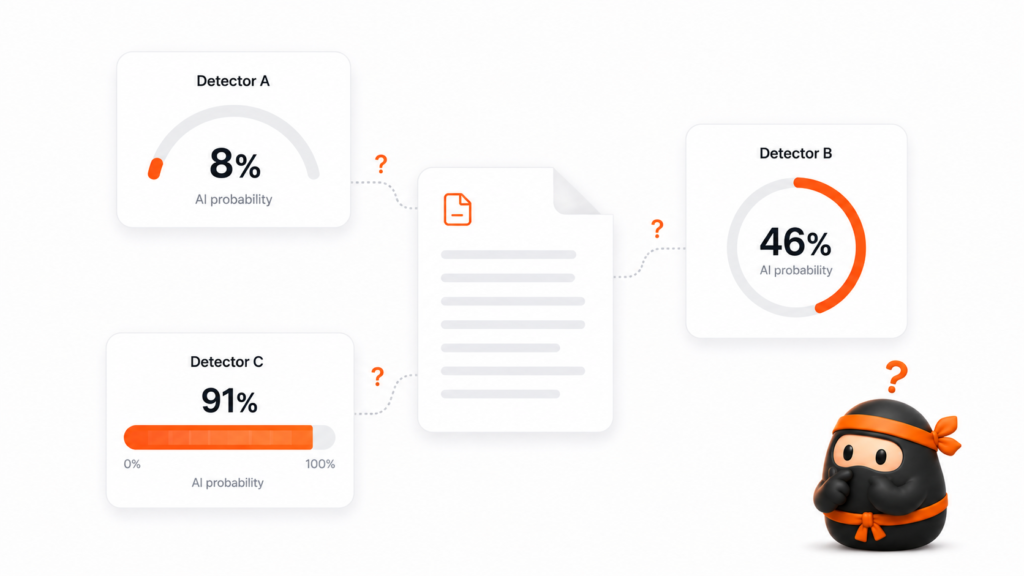
These differences occur because each company uses its own algorithms, training data, and scoring methods.
For this reason, detection scores should be interpreted cautiously rather than treated as objective measurements.
Non-Native English Writers Face Additional Challenges
People writing in a second language sometimes experience higher AI scores.
This happens because many language learners intentionally use:
- shorter sentences;
- familiar vocabulary;
- standard grammar patterns;
- predictable transitions.
These characteristics help ensure clarity but may also resemble the style commonly generated by AI writing assistants.
This does not mean the writing lacks originality—it simply reflects a careful approach to communicating in another language.
AI Assistance Doesn’t Always Mean AI Authorship
Modern writing often involves some form of AI assistance.
People may use AI to:
- brainstorm ideas;
- generate outlines;
- improve grammar;
- simplify difficult sentences;
- summarize research.
The final document may still require substantial human editing, fact-checking, restructuring, and original thinking.
As a result, today’s writing often exists on a spectrum rather than falling into simple categories of “AI” or “human.”
This is another reason why binary judgments based solely on detector scores can be misleading.
What Writers Should Do Instead
Rather than worrying exclusively about AI detection scores, writers should focus on producing high-quality content.
Strong writing typically demonstrates:
- accurate information;
- logical organization;
- original insights;
- clear explanations;
- appropriate tone for the audience.
If AI tools are used during the writing process, thoughtful editing can ensure that the final result reflects the author’s own knowledge and communication style.
Ultimately, readers care more about usefulness, clarity, and credibility than about whether software assisted during early drafting.
The Future of AI Detection
As language models continue to improve, distinguishing between AI-generated and human-written content will become increasingly difficult.
Future detection systems will likely become more sophisticated, but so will writing tools.
Many experts therefore believe that education, publishing, and professional communication will gradually shift away from asking, “Was AI involved?” and toward more meaningful questions:
- Is the information accurate?
- Is the work original?
- Does it demonstrate understanding?
- Does it provide value to readers?
These questions are ultimately more important than any probability score produced by an automated detector.
Conclusion
Human writing can be flagged as AI for many reasons, including formal language, consistent sentence structure, extensive editing, or simply matching statistical patterns commonly found in machine-generated text. Because AI detectors estimate probabilities rather than identify authorship, false positives remain an unavoidable part of the technology.
For writers, the best approach is to prioritize authenticity, accuracy, and clear communication instead of trying to optimize for any single detection tool. Well-written content should first serve its readers, regardless of how it was created.
Refining AI-Assisted Writing
Many writers use AI to speed up drafting while relying on careful editing to produce natural, readable content. Tools like Humanio AI help improve AI-assisted text by increasing linguistic variety, refining sentence flow, and preserving the writer’s intended meaning.