



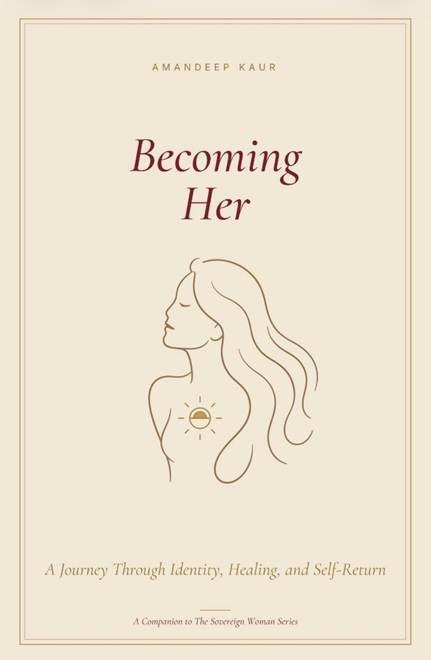
Many women spend years conforming to expectations, often abandoning their own needs to gain acceptance, love, or understanding. When old identities collapse and the desire to choose oneself arises, the transition can feel overwhelming. Stepping away from familiar patterns requires moving through an uncertain in-between space where old habits fade, but new routines are not yet fully established.
Amandeep Kaur, author of The Sovereign Woman Series and founder of Ambika Coaching & Consulting, helps women navigate this essential transition. Through her companion book, Becoming Her: A Journey Through Identity, Healing, and Self-Return, Kaur offers an intimate exploration of emotional wellness, self-worth, inner trust, and what it means to find safety within yourself. The book reached #1 in four Amazon Kindle categories: Interpersonal Relations, Codependency, Emotions, Self-Help eBooks, and Self-Management Self-Help eBooks. It also reached #6 in Personal Transformation.
In this interview, Kaur discusses the nuances of personal transformation, building safety from within, and leading a life rooted in self-alignment.
Q: What inspired you to write Becoming Her: A Journey Through Identity, Healing, and Self-Return as a companion to the first three books in The Sovereign Woman Series?
Amandeep Kaur: The first three books were really about recognizing patterns, choosing yourself, and beginning the process of rebuilding. Becoming Her came from realizing that there is another part of healing that we do not talk about enough — what happens after you understand what needs to change.
There is this period where you have done so much inner work, but you are still learning how to live differently. You may no longer identify with the person you were, but you are also not completely settled into who you are becoming.
I was living that in real time.
I was learning to trust myself differently, listen to my body, understand what emotional safety actually meant to me, let go of roles and expectations that no longer fit, and allow my life to unfold without trying to control every outcome.
So Becoming Her became less about teaching from the other side of something and more about documenting what it actually feels like while you are still becoming. I wanted women to know that they do not have to have everything figured out in order to be healing. Sometimes the transformation is happening in the uncertainty itself.
Q: In Becoming Her, you focus heavily on the “in-between stage” of healing. Why is this phase often the hardest part of personal transformation, and how can women navigate it effectively?
Amandeep Kaur: I think the in-between can be difficult because the familiar may no longer feel right, but the new life has not fully taken shape yet.
Even when an old pattern was unhealthy or exhausting, it was still familiar. There can be comfort in knowing who you are supposed to be, what role you are supposed to play, or what comes next. When you begin letting those identities go, there is suddenly space — and space can feel uncomfortable before it feels freeing.
For me, navigating that stage became less about trying to immediately fill the space and more about learning how to stay present inside it.
That meant slowing down. Paying attention to what my body was telling me. Allowing myself to rest without feeling like I needed to earn it. Spending time alone without automatically interpreting solitude as loneliness. Letting myself enjoy my life before every question had an answer.
I think we sometimes try to rush healing because uncertainty makes us uncomfortable. But there is so much information in that period. If you stop trying to force the next chapter, you begin hearing yourself much more clearly.

Q: A central theme in your work is learning how to stop abandoning oneself for external acceptance. What are the first practical steps a person can take to recognize and break that habit?
Amandeep Kaur: I think the first step is simply becoming curious about the moments when you override yourself.
Where are you saying yes when something inside you wants to say no?
Where are you explaining yourself excessively because you are afraid someone may misunderstand you?
Where are you exhausted, resentful, anxious, or uncomfortable, but continuing anyway because you do not want to disappoint someone?
Our bodies often recognize self-abandonment before our minds do.
One of the simplest practices I learned was to create a pause. I did not have to immediately answer every request, solve every problem, or make every decision. I could ask myself, “What do I actually want? What do I need right now? Does this feel aligned with me?”
And then you practice honoring the answer in small ways.
Choosing yourself does not have to begin with some dramatic life decision. Sometimes it begins with resting when you are tired. Saying no without writing a paragraph explaining why. Asking for help. Leaving something for tomorrow. Changing your mind.
Those small moments teach you that you can trust yourself.
Q: You recently hosted the “Becoming Her: Brunch, Bloom & Book Celebration” in Boston. How does bringing women together in community accelerate individual healing compared to reading and reflecting alone?
Amandeep Kaur: One of the most meaningful parts of that celebration was looking around the room and realizing how many different people had been part of my journey in some way.
Healing can feel incredibly personal and solitary. There are parts of it that no one else can do for you. But I also learned that becoming yourself does not mean doing everything alone.
Community reminds us that we are allowed to be witnessed.
At the celebration, women were reflecting, writing letters to their future selves, creating bouquets, taking photographs, talking, laughing, and simply being together. The book may have started with my story, but the experience became something shared.
That mattered to me because sometimes another woman’s courage gives you permission to look at your own life differently. Sometimes hearing someone say, “I have felt that too,” creates its own kind of healing.
I used to think strength meant being able to carry everything myself. Now I think part of strength is also allowing yourself to receive support, connection, encouragement, and love when it is offered.
Q: Through Ambika Coaching & Consulting, you focus on helping women build a sense of safety from within. What does inner safety look like in practice when facing everyday pressures or major life decisions?
Amandeep Kaur: For me, inner safety means knowing that I will not abandon myself regardless of what happens around me.
It does not mean never feeling anxious, uncertain, disappointed, or overwhelmed. It means being able to experience those emotions without immediately believing that something has gone wrong or that I need to fix everything.
It can look very ordinary.
Giving yourself time before making a major decision. Recognizing when your body is asking you to slow down. Setting a boundary even when someone else may not understand it. Allowing yourself to change direction. Trusting that disappointment does not mean you made the wrong choice.
For a long time, I think I associated safety with someone or something outside of me — a relationship, certainty, knowing what would happen next, having “my person.”
Eventually I realized that the most important safety I could build was the relationship I had with myself: knowing that whatever happened, I would listen to myself, care for myself, advocate for myself, and find my way through it.
That foundation also changes the relationships you allow into your life. You are no longer asking another person to become your entire source of safety. You are looking for someone who can meet you there and contribute to the safety, consistency, and love you have already learned to value.
Q: For readers who feel stuck in old expectations and want to begin trusting themselves with less control, what core message do you hope they take away from your body of work?
Amandeep Kaur: That you are allowed to create a life that actually feels like yours.
So many of us learn to live according to expectations — who we should be, what we should accomplish, when things should happen, what relationships should look like, how much we should give, and how much of ourselves we should sacrifice in order to be loved or considered good.
At some point, you have to ask whether the life you are working so hard to create is actually the life you want.
The message underneath all of my work is not that you need to become someone entirely different. It is that you can return to yourself.
You can trust what you feel. You can honor what you need. You can release what no longer fits without making the past wrong. You can be grateful for what something taught you and still know that it is time to move forward.
And you do not have to know exactly where everything is leading.
There was a time when I thought peace would come from finally having all the answers. What I am learning instead is that peace comes from trusting myself even when I do not.
That, to me, is what becoming her really means.
Navigating personal growth requires more than simply recognizing past patterns; it demands patience as new ways of living take root. As Amandeep Kaur highlights, returning to oneself is an ongoing process of listening to the body, deepening self-trust, and releasing the need for external validation.
True personal transformation begins when individuals build sustainable emotional safety from within. By combining community connection, literature, reflective resources, and educational content, Ambika Coaching & Consulting creates opportunities for women to reconnect with themselves and explore more authentic, empowered ways of living.
To learn more, visit www.ambikacoachingconsulting.com