



© photo by
copenhagenatomics.com
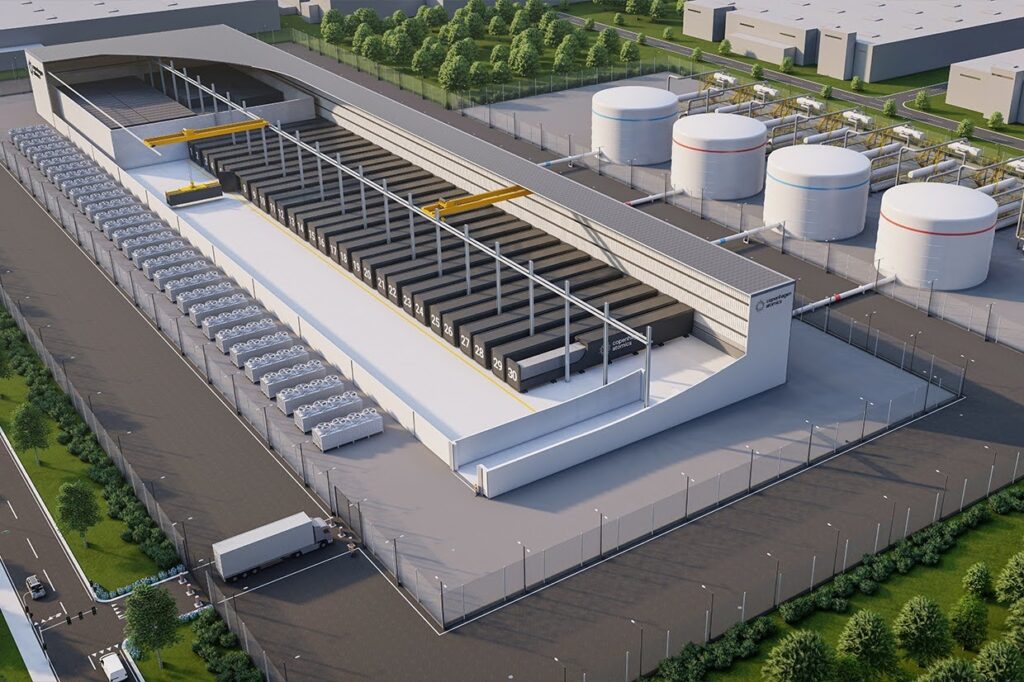
A company founded by four Danish engineers is seeking to change the economics of nuclear power by betting that a standardized reactor unit, capable of breeding its own fuel and built on a production line rather than assembled on a work site, could address one of the industry’s longstanding challenges. In 2028, at a Swiss research center, the venture plans to put that approach to a significant test.
At the edge of Copenhagen, in a factory in Kastrup, a pump has been running without a break for more than two years. It is moving molten salt at a temperature of 600 degrees Celsius, a component that has long presented a significant engineering challenge. A few meters away, a crew is assembling the company’s full-scale reactor unit prototype.
If you ask why nuclear power is expensive, you will usually hear about complex engineering, safety requirements and decades of regulatory discussions layered on top of large infrastructure projects. Copenhagen Atomics has a different explanation. In the United States and Europe, many nuclear power plants have been built as individual projects, with designs and construction processes that are difficult to repeat. The price can reflect that. America’s Vogtle expansion in Georgia is a cautionary example: two reactors that ran to around $35 billion, several times their early budget and a 15-year construction timeline, partly because Westinghouse went bankrupt mid-construction and the country had to rebuild a nuclear workforce that had not been utilized since the 1970s.
In China, the experience has been different. Early builds of the same designs ran late, but repeated construction of standardized designs, supported by state financing and an established supply chain, has helped the country complete reactors in about five years and at a fraction of the Western cost in some cases. Repetition can make a difference. That is one part of what Copenhagen Atomics is attempting to apply to nuclear power. By building reactors on a production line, the company argues that each unit could benefit from lessons learned during the previous one, with the same teams and manufacturing processes becoming more efficient over time. Jet engines followed a similar path, as did the automobiles now filling roads around the world.
The other part of Copenhagen Atomics’ approach concerns the reactor’s fuel. Instead of relying solely on enriched uranium, as conventional plants do, the company’s design uses thorium and, in its longer-term plans, could make use of spent nuclear fuel from other reactors. The company describes both materials as abundant sources for its proposed fuel cycle. The approach is built around a liquid-fuel core that Copenhagen Atomics calls the Onion Core®, which the company sees as an important part of its reactor design.
Here’s what that means in numbers. Copenhagen Atomics is targeting a cost of $29-$39 per megawatt-hour of electricity, of which the reactor unit and the fuel it uses contributes $9. In comparable nuclear projects, a similar price range covers only the fuel needed. The rest is determined by what the power plant owner builds around it. For comparison, Lazard’s 2026 benchmark puts the levelized cost of new conventional nuclear at roughly $175 to $255 per megawatt-hour, up from $141 to $220 a year earlier, against $37 to $99 for onshore wind and $40 to $98 for utility-scale solar. One caveat matters: levelized cost calculations can favor wind and solar because they do not fully capture intermittency and the additional infrastructure needed to provide electricity when those sources are unavailable. That can include batteries and backup generation.
Whether Copenhagen Atomics can achieve its projected costs remains an open question. The company has set a date that could provide an important test. In 2028, a demonstration reactor is scheduled to reach its first controlled chain reaction at the Paul Scherrer Institute (PSI), Switzerland’s largest research institute for the natural and engineering sciences.
The timing is not an accident
This effort is taking place as electricity demand enters a period of rapid growth. Consumption is rising faster than grids were built to handle, driven by electrification and, above all, by the growing demand for power from data centers running artificial-intelligence workloads. The International Energy Agency (IEA) estimates global electricity demand will rise more than 3.5% annually through 2030, roughly two and a half times faster than overall energy demand. Morgan Stanley’s 2026 outlook warns of a shortfall of roughly 49 gigawatts in available U.S. power by that date. The buyers of this power include some of the world’s best-capitalized companies, many of which are seeking reliable electricity on timelines measured in years rather than decades.
Capital has also begun moving toward advanced nuclear technology. Advanced-nuclear companies raised about $1.3 billion in equity in 2025, according to Net Zero Insights, the sector’s highest annual total on record, with small modular and micro-reactor developers accounting for roughly three-quarters of it. Governments that had spent years limiting new nuclear development have begun changing course, with new-build incentives and licensing reforms on both sides of the Atlantic. The shift is not limited to the West. The IEA expects emerging economies to account for much of the growth through 2030, while advanced economies are expected to account for only about a fifth.
Old physics, hard engineering
The underlying physics was demonstrated in the 1960s, when Oak Ridge National Laboratory operated the Molten Salt Reactor Experiment for thousands of hours. But turning the concept into a commercially viable reactor has involved decades of engineering, regulatory and economic challenges.
Politics played a role in the development of nuclear power, but a thorium reactor also presented difficult engineering problems. That is the problem Copenhagen Atomics has spent its existence working on. Founded in 2014, the company chose a path of continuous component development and testing rather than relying on large-scale announcements. In 2026, it reported two years of unbroken operation of a molten salt pump, one of the components that has presented longstanding challenges for reactor development. Across the program it now counts more than 450 combined years of component and materials testing, and 13 patent families. The objective is to move the technology from experimental work toward a reactor design that can eventually be manufactured systematically. The company’s own description of its culture is that it builds reactors rather than presentations, reflecting its emphasis on hardware and testing.
What sets Copenhagen Atomics apart, according to the company, is its Onion Core® technology and its goal of developing a breeder reactor in the thermal spectrum. If the approach can be demonstrated at the required scale, it could address one of the longstanding challenges in nuclear technology: producing more usable energy from the material placed in the reactor. The company’s longer-term design uses thorium and could also use spent nuclear fuel, while seeking to extract a much larger proportion of the energy contained in the original material than conventional reactors. The broader proposition is that a reactor designed for standardized manufacturing could eventually benefit from manufacturing efficiencies similar to those seen in other forms of industrial equipment.
The company has also begun developing its fuel supply chain. A number of LOIs and MOUs have been signed with mining companies, and the company says it has already bought 20 tons of thorium from existing stockpiles. It also holds a separate collaboration agreement covering the handling and disposal of nuclear materials. These arrangements are intended to address some of the supply-chain questions that could become more important if the reactor moves toward commercial deployment.
What 2028 changes
Every pre-revenue hardware company asks others to place some confidence in engineering that has not yet operated at full scale. A dated demonstration matters because it can replace some of that uncertainty with measurable results.
Today, Copenhagen Atomics is working toward a demonstration that could provide evidence about whether its reactor design can sustain a controlled chain reaction under operating conditions. If the 2028 test proceeds as planned, the company will have an opportunity to compare the results with the engineering assumptions and simulations that underpin its longer-term commercial plans. The significance of the milestone will depend on what the demonstration actually shows.
Credibility will not rest on the demonstration alone. Copenhagen Atomics says it already earns revenue from four commercial product lines, among them molten salt test loops, specialized salts, enriched lithium isotopes and testing services, sold to technology and research institutions, national laboratories and other reactor developers. Those activities provide the company with commercial operations alongside its reactor-development program, although they do not establish that the proposed commercial reactor will work at scale.
The company is backed by more than 200 private investors across 20 countries, with high-net-worth individuals and family offices representing a significant part of its investor base. Its current capital-raising activity is intended to support the company’s development toward the 2028 demonstration and the engineering work surrounding it.
What could go wrong
Any assessment of Copenhagen Atomics has to weigh the risks alongside the potential benefits, and those risks are substantial.
The first is the gap between a successful demonstration and a shipped product. A first chain reaction in 2028 would provide evidence that the reactor can operate as intended under the conditions of the demonstration. On its own, however, it would not establish that the reactor can be licensed in commercial markets, manufactured at scale, or delivered at the company’s projected cost. Those are separate challenges that could take years to resolve.
The second is regulation and supply chain. A thorium and used-fuel reactor would present regulators with a technology that differs from conventional nuclear plants, while the fuel and materials supply chains it relies on are still developing. The letters of intent and other agreements signed so far could reduce some of that exposure without eliminating it.
The third is time. The same demand growth and financing environment that has increased interest in advanced nuclear technology is also supporting a crowded field of developers. Technical progress will therefore need to be accompanied by progress in manufacturing, regulation and deployment. Missing a major demonstration milestone could delay the company’s plans and affect how the market views its technology.
This helps explain why the 2028 demonstration carries so much weight. It is a point at which several of the company’s current projections can begin to be tested against operating evidence.
The next test
This is not a finished story, and Copenhagen Atomics does not present it as one. What the company is aiming for is a specific, dated demonstration in a market where demand for electricity has become a major constraint for some of the fastest growing industries in the world.
Before 2028, the company is a research-and-development business with a deep engineering record built around component testing and prototype development. A successful demonstration would provide additional evidence about the reactor design, its fuel cycle and the assumptions behind its manufacturing model. The company would in this case have three things that few other companies do: a reactor capable of sustaining a chain reaction, the intellectual property and the in-house capability to make 90% of the fuel, the reactor and its components. All this provides more evidence that a commercial thorium breeder in the thermal spectrum is within reach.
The company’s longer-term plans also depend on moving beyond the initial demonstration toward full commercial reactors. Those plans include further developing a reactor capable of operating with thorium and, eventually, potentially using transuranics from spent nuclear fuel. The company’s simulations have been cross-checked and published with the Paul Scherrer Institute using OpenMC, the reactor-physics code developed at the Massachusetts Institute of Technology and Argonne National Laboratory.
As the only company in this new technology area, the 2028 demonstration will therefore be an important test of whether Copenhagen Atomics’ approach can move beyond component testing and simulation toward a functioning reactor. It will not settle every question surrounding advanced nuclear power, but it could help evaluate whether the company’s technical and economic assumptions can hold up under operating conditions.