



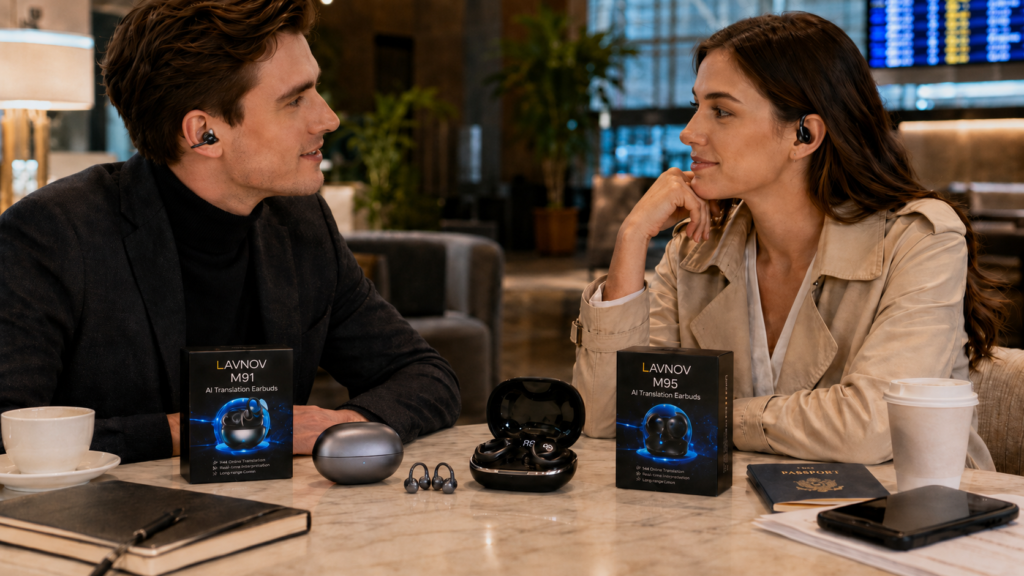
Translation earbuds are designed to make conversations between people who speak different languages more convenient. Instead of repeatedly passing a phone back and forth, users can speak, listen, and respond with fewer interruptions. This can be useful for international travelers, multilingual families, language learners, and professionals working across borders.
However, the best translation earbuds are not necessarily the pair with the longest language list. A useful model needs to work with your phone, support the languages you actually need, remain comfortable, and offer practical conversation modes. Before buying, focus on these seven features.
At a glance: Prioritize language and accent coverage, conversation modes, offline availability, microphone performance, comfort, battery life, and app compatibility. Test the complete setup before the return period ends.
1. Useful Language and Accent Coverage
A large language library can sound impressive, but the number alone does not tell you whether the earbuds will meet your needs. First, check whether both sides of your required language pair are supported. Then consider regional accents and dialects. Spanish, for example, can differ noticeably between countries, while English also varies by region.
It is also important to distinguish online and offline translation. A device may advertise more than 100 languages while supporting fewer languages without an internet connection. If you expect limited connectivity or want to avoid roaming charges, confirm that your essential language pair can be downloaded and used offline.
2. Conversation Modes That Fit Real Life
Translation earbuds often work alongside a companion app and can provide different conversation methods. In shared-earbud mode, each person wears one earbud. This can be convenient with someone you know, although strangers may prefer not to share an earpiece. Speaker mode keeps the phone involved and can be more practical in shops, hotels, restaurants, and taxis. Push-to-talk options can also reduce unintended speech pickup.
A mode that works well in a quiet meeting may be less practical in a crowded airport. Having several conversation options gives users more flexibility instead of requiring every interaction to follow the same process.
3. Translation Speed and Realistic Accuracy
No consumer translation system should be treated as perfect. Performance can change with background noise, speaking speed, slang, technical terminology, pronunciation, and sentence length. Manufacturer accuracy percentages can also be difficult to compare because companies may use different testing conditions. Treat them as specifications or claims rather than guarantees of real-world performance.
Short, clear sentences are generally easier for automated systems to process than long explanations. Pausing between thoughts and avoiding overlapping speech can also help. For prices, addresses, dates, contracts, medication instructions, or other important information, confirm the details in writing. Some processing delay is normal because the system must capture, recognize, translate, and play the speech.
4. Online, Offline, and App Requirements
The companion app may handle important parts of recognition and translation. Before purchasing, check compatibility with your version of iOS or Android, account requirements, language-pack availability, permissions, and whether important features require a subscription.
Offline functionality may require language packs to be downloaded in advance and can use phone storage. Download the required languages and test them in airplane mode before traveling. For workplace conversations, also review how the app handles recordings, transcripts, and cloud processing. Hearing a translated conversation through earbuds does not automatically make the underlying data private or confidential.
5. Microphone and Noise Management
Clear speech input is essential to useful translation. If the microphones capture traffic, music, wind, or nearby conversations instead of the intended speaker, even a capable translation system can produce poor results. Look for microphones designed to focus on speech and technologies intended to reduce unwanted background noise.
Do not confuse active noise cancellation for the listener with microphone noise reduction for speech capture. They address different problems. Call quality is also worth testing because microphones that perform well during ordinary calls can make the earbuds more useful beyond translation.
6. Comfort, Fit, and Situational Awareness
A translation session can last considerably longer than a single song, so comfort matters. Consider ear-tip sizes, overall weight, pressure, and whether the earbuds remain secure while walking.
Open-ear or clip-on designs leave the ear canal less obstructed and can help users remain aware of announcements, traffic, and surrounding conversations. Sealed designs may provide greater isolation and stronger passive noise reduction. The appropriate style depends on whether you prioritize environmental awareness, privacy, comfort, or noise control.
7. Battery Life and Everyday Value
When comparing battery specifications, distinguish battery life per charge from the combined figure provided by the charging case. A large total may be less useful if the earbuds themselves run out of power during a conversation. Charging speed and a commonly supported connector such as USB-C can also be important when traveling.
Earbuds that support music and calls as well as translation may offer greater everyday value. A device used regularly is easier to keep charged, updated, and familiar. Also consider warranty coverage, return policies, replacement options, software support, and the availability of customer service.
A Practical Example of What to Compare
When evaluating real-time translation earbuds, product pages can provide useful specifications such as supported languages, accent coverage, conversation modes, offline capabilities, and compatibility with music or calls. For example, Lavnov’s current product information lists 144 languages, more than 70 accents, five modes, photo translation, offline options, and music and call support. These figures should be treated as manufacturer specifications and checked against the exact model and current software before purchase.
Before the return period ends, test the earbuds during a quiet conversation, a noisier environment, and an offline session if that feature is important to you. If possible, ask a fluent speaker to assess whether the translated meaning is accurate rather than judging individual words alone. A real-world trial can reveal limitations that are not obvious from a specification sheet.
Final Verdict
The best translation earbuds are the ones that reduce friction during the conversations you actually expect to have. Prioritize the correct language pair, useful conversation modes, dependable app support, clear microphones, comfortable fit, and sufficient battery life. Treat translation technology as a communication aid rather than an infallible interpreter, especially when information involves legal, financial, medical, or safety consequences.
Brands such as Lavnov offer translation-focused earbuds with different features and configurations, but specifications can vary by model and change through software updates. Compare current model-level details, verify compatibility with your phone, test the complete app-and-earbud experience, and choose the option that best matches the situations in which you expect to use it.
Disclaimer: Product specifications, language support, compatibility, software features, and offline capabilities can change. Verify current information with the manufacturer before purchasing.