



Enterprise software projects fail at a rate that should make every CTO uncomfortable.
Not fail dramatically — fail quietly. Delivered late. Delivered over budget. Delivered technically but not actually used by the people it was built for. Or delivered, used for a year, and then replaced because the architecture couldn’t support what the business needed it to do next.
The pattern is consistent enough that it has a name in the industry: “successful failure.” The project ships. The vendor gets paid. Nothing changes.
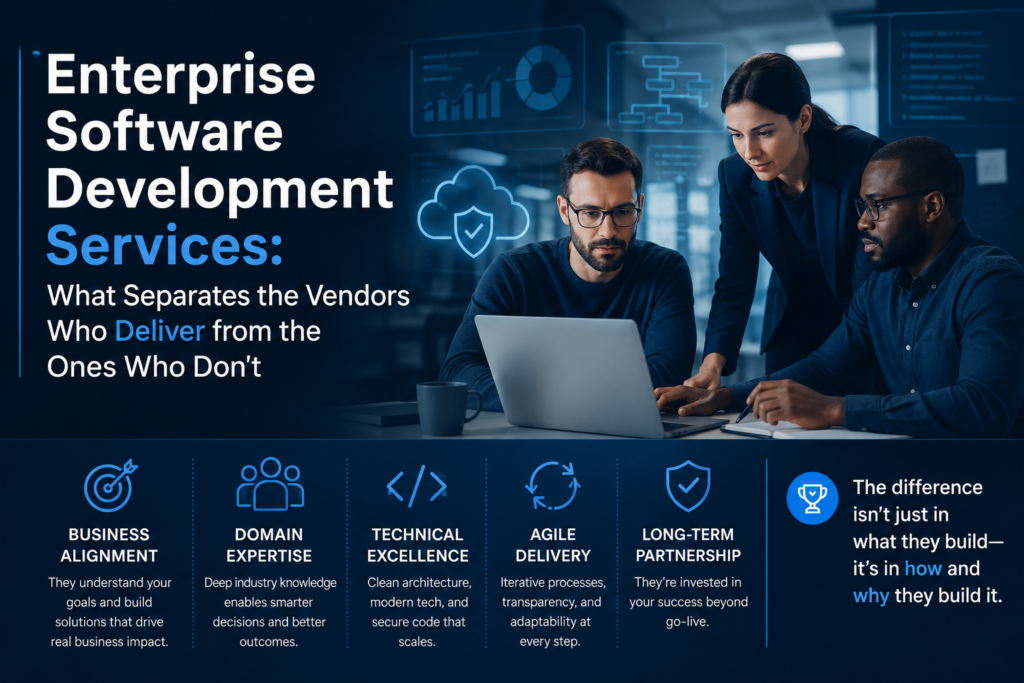
Why Enterprise Software Projects Actually Fail
The failure modes cluster around the same issues every time.
Requirements that weren’t requirements. The initial scoping captured what stakeholders said they wanted, not what the business actually needed. These are different things. What people ask for and what solves the underlying problem are often only loosely related. Enterprise software projects that skip deep discovery — treating requirements gathering as a checkbox rather than an investigation — build the wrong thing with precision.
Architecture decisions made too early or too cheaply. The technical decisions made in the first few weeks of a project constrain everything that follows. Database design, integration architecture, security model, scalability approach — get these wrong and you’re paying to redo them later, usually under pressure, usually at the worst possible time. Good enterprise software development services push hard on architecture before development starts. Vendors who want to move fast skip this and call it agility.
Integration underestimated. Enterprise systems don’t exist in isolation. They connect to ERP systems, CRM platforms, legacy databases, third-party APIs, authentication providers. Every integration is a potential failure point. Every integration takes longer than estimated. Projects that treat integration as a late-stage detail rather than a core architectural concern consistently run into the same wall six months in.
No real ownership on the client side. External vendors can build software. They can’t own it for you. Enterprise projects that don’t have a strong internal product owner — someone with authority, availability, and a clear understanding of business requirements — drift. Scope changes accumulate without prioritization. Decisions get delayed. The vendor builds what they’re told without the business context to push back when something is wrong.
Handoff as an afterthought. The project delivers. The vendor leaves. The internal team inherits a codebase they don’t understand, documentation that’s incomplete, and no knowledge of why specific decisions were made. Within a year, the system is a black box that nobody wants to touch. Maintenance costs escalate. Enhancements become expensive. The software that was supposed to be an asset becomes a liability.
What Good Enterprise Software Development Actually Looks Like
The process that avoids these failures isn’t complicated. It’s disciplined.
Discovery Before Development
A serious enterprise software engagement starts with weeks of discovery before anyone writes a line of code.
Not requirements gathering — discovery. The difference matters. Requirements gathering asks what people want. Discovery investigates what problems actually exist, what current processes look like and where they break down, what success looks like in measurable terms, and what the system needs to do in three years, not just at launch.
The output of discovery is a functional specification, a technical architecture recommendation, and a project plan built on actual understanding — not on what was feasible to scope in a sales call.
Architecture That Serves the Business, Not the Vendor
The architecture decisions that matter most in enterprise software:
How will the system scale as data volume and user count grow? How will it integrate with existing systems — and with the systems the business will adopt over the next few years? How will security and compliance requirements be met? How will the system be maintained and extended after the initial build?
These questions have answers that depend on the specific business context. Generic architecture — “we’ll use microservices” or “we’ll build on AWS” — without context-specific reasoning is not architecture. It’s template application. Good enterprise software development services provide architecture that fits the specific situation, not a default stack applied regardless of requirements.
Development With Real Visibility
Enterprise clients shouldn’t be waiting for delivery to see what they’re getting.
Sprint reviews with working software — not status updates, not slide decks, working software — at regular intervals. A shared environment where the client can see progress in real time. A project management setup that makes it clear what’s been built, what’s in progress, and what’s coming next.
This visibility serves two purposes: it catches misalignment early when it’s cheap to fix, and it builds the trust that makes the difficult conversations easier when they need to happen.
Integration as a First-Class Concern
Every integration in the project should be mapped, scoped, and planned before development begins — not discovered during development.
That means understanding the APIs and data formats of every system being connected. Understanding the reliability and rate limits of third-party services. Building integration layers with proper error handling, retry logic, and monitoring. Testing integration points with real data from real systems before go-live.
Integration failures are the most common cause of enterprise software launches that go badly. They’re almost entirely preventable with proper upfront planning.
Knowledge Transfer Built Into the Plan
The engagement should end with the client team able to own, maintain, and extend what was built.
That means documentation that reflects what was actually built — not what was planned to be built. Architectural decision records that explain why key choices were made. Codebase walkthroughs for the internal team. A transition period where questions can be answered before the vendor is fully off the project.
Knowledge transfer planned from day one rather than improvised at the end is the difference between software that remains maintainable and software that becomes a legacy burden within two years.
What to Look for When Evaluating Vendors
The sales process for enterprise software vendors is well-optimized. Everyone presents well. The questions that actually reveal capability require pushing past the pitch.
Ask to speak with a client whose project had problems. Every serious vendor has navigated difficult projects. How they talk about what went wrong and how they handled it reveals more than any success story.
Ask how they handle scope changes mid-project. Scope changes happen in every enterprise project. How a vendor manages them — in terms of process, communication, and commercial handling — determines whether the project stays on track or spirals.
Ask what the handoff process looks like. If the answer is vague or improvised, that’s the answer.
Review a sample of their code from a previous project. Code quality is visible. Documentation quality is visible. If they won’t share it, that’s information too.
Ask about their discovery process specifically. How long does it take? What does it produce? Who’s involved? A vendor who can’t describe their discovery process in specific terms probably doesn’t have one.
At instinctools.com, enterprise software development services start with a structured discovery engagement before any development begins. The output — a functional specification, a technical architecture recommendation, and a realistic project plan — is what everything that follows is built on. Development is done by senior engineers who’ve built and maintained enterprise systems in production, not junior teams supervised from a distance. And knowledge transfer is planned from the start, not improvised at the end.