



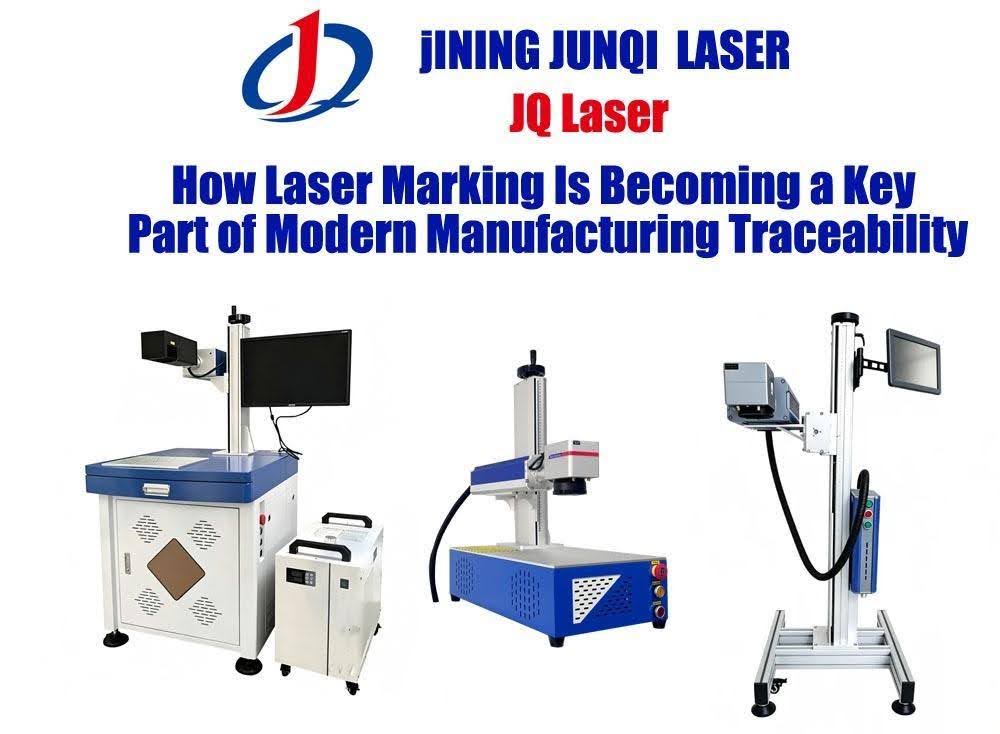
Manufacturing traceability used to depend heavily on labels, printed codes, paperwork and manual records. Today, many manufacturers are moving toward permanent identification methods that can connect a physical component with digital production information throughout its life cycle.
Laser marking is one technology supporting this transition. Instead of applying an ink label or attaching a separate identification tag, a laser can create information directly on the surface of a component. Depending on the material and process, manufacturers can mark serial numbers, QR codes, Data Matrix codes, logos, part numbers, batch information and other identification data.
The technology is particularly relevant when manufacturers need permanent identification, repeatable marking quality and integration with automated production systems.
Why This Matters
Modern traceability is no longer only about putting a number on a product. The identification mark needs to remain readable, correspond to the correct production record and fit into the manufacturing workflow.
Laser marking can support this process because the marking operation can be integrated with digital data, production equipment and automated inspection systems.
1. What Is Manufacturing Traceability?
Manufacturing traceability is the ability to identify and follow a product, component or production batch through different stages of manufacturing and distribution.
A manufacturer may need to know:
- Which production batch created a component
- When the component was manufactured
- Which production line processed it
- Which machine or workstation was involved
- Which serial number belongs to the product
- Which customer received the component
- Whether the component passed inspection
For a simple consumer product, a printed label may be sufficient.
For industrial components, however, the identification mark may need to survive handling, cleaning, assembly and long-term use.
This is one reason permanent marking technologies have become increasingly relevant to industrial manufacturers.
2. Why Manufacturers Use Laser Marking
Laser marking does not require physical contact between a conventional marking tool and the workpiece. Instead, a focused laser beam interacts with the material surface to create a visible or physical change.
Depending on the material and process, the result may involve surface color change, material removal, coating removal, engraving or other controlled surface effects.
For manufacturers, several characteristics are particularly useful.
Permanent Identification
A properly developed laser marking process can produce identification that is significantly more durable than many temporary labels or printed markings.
Digital Content
Laser marking systems can process changing information such as serial numbers, production codes and machine-generated data.
Small Marking Areas
Laser systems can create relatively small characters, codes and graphics, making them useful for compact industrial components.
Automation
Laser marking can be integrated with conveyors, sensors, PLC systems, robotic handling and vision inspection depending on the application.
3. Laser Marking and Digital Product Identification
One of the more important changes in manufacturing is the transition from static product labels to dynamic identification.
Consider a production line manufacturing 10,000 components.
Instead of marking the same batch number on every component, the manufacturer may assign a unique identification code to each individual part.
The production system can then associate the code with information such as:
- Production date
- Production batch
- Machine number
- Inspection result
- Material batch
- Customer order
- Quality-control information
The physical laser mark becomes the connection between the manufactured component and its digital record.
4. QR Codes and Data Matrix Codes
Two-dimensional codes are particularly useful when manufacturers need to store more information within a limited physical area.
Data Matrix and QR codes can be used for different applications depending on the industry and the information system behind them.
For industrial components, the important issue is not simply whether a laser can create a code that looks correct.
The code must also remain readable.
That means manufacturers should evaluate:
- Contrast
- Module size
- Surface condition
- Marking depth
- Code quality
- Reading distance
- Lighting conditions
- Camera or scanner configuration
A visually acceptable code is not necessarily a production-quality code if automated readers cannot reliably decode it.
5. Why Material Matters
Laser marking is not a one-process-fits-all technology.
The material determines how the laser energy interacts with the surface, and surface coatings or treatments can also influence the final result.
Fiber lasers are commonly associated with industrial metal marking. UV lasers are often considered for fine marking on selected plastics and other sensitive materials. CO₂ lasers are commonly used for materials such as wood, acrylic, paper, leather and certain plastics.
Fiber Laser
Commonly used for metal identification and industrial marking. Typical materials include stainless steel, aluminum, steel, brass, copper and titanium.
MOPA Fiber
Used for specialized metal and plastic marking applications, including anodized aluminum, stainless steel and selected plastics.
UV Laser
Often considered for fine and lower-thermal-impact marking on plastics, electronics, glass, ceramics and selected metals.
CO₂ Laser
Commonly used for non-metal marking and coding on materials such as wood, acrylic, leather, paper and selected plastics.
Manufacturers should therefore test the actual material before selecting a final laser configuration.
6. Fiber Lasers in Industrial Manufacturing
Fiber laser technology is widely used in applications where manufacturers need to identify metal components.
Typical examples include:
- Automotive components
- Machine parts
- Industrial tools
- Hardware components
- Electrical parts
- Metal housings
- Stainless-steel components
- Aluminum components
- Industrial nameplates
- Metal identification plates
Common marking content includes serial numbers, logos, part numbers, barcodes, QR codes, Data Matrix codes and production information.
For manufacturers evaluating this technology, fiber laser marking technology can be considered as part of a broader industrial identification strategy rather than simply as a replacement for engraving or printing.
7. Laser Power Is Only One Part of the Equation
When purchasing industrial laser equipment, buyers often begin with laser power.
20W, 30W, 50W and 100W are common power categories for pulsed fiber marking systems, but power alone does not determine the final production result.
The actual process can also depend on:
- Laser source characteristics
- Scanning system
- F-theta lens
- Marking field
- Frequency
- Pulse characteristics
- Scanning speed
- Hatch spacing
- Number of passes
- Material condition
- Workpiece positioning
For example, a manufacturer performing simple serial-number marking may have completely different requirements from another company performing deep engraving on a steel component.
For that reason, selecting a laser based only on wattage can lead to an unnecessarily expensive or unsuitable configuration.
8. Production Speed Versus Scanner Speed
Another common misunderstanding involves marking speed.
A laser supplier may specify a maximum scanning speed measured in millimeters per second. That specification describes a capability of the scanning system, but it does not necessarily represent the complete production cycle time.
In a real factory, the production cycle may include:
- Loading the part
- Positioning the part
- Reading identification information
- Focusing or checking the work area
- Laser marking
- Inspection
- Unloading the part
For high-volume manufacturing, the total cycle time is usually more meaningful than a maximum scanner-speed figure printed on a specification sheet.
9. Automation Makes Traceability More Powerful
Laser marking becomes particularly useful when it is connected to a broader manufacturing system.
A production line may combine the laser marker with:
- Conveyors
- Photoelectric sensors
- Encoders
- PLC controls
- Robotic arms
- Automatic fixtures
- Vision cameras
- Barcode readers
- Manufacturing databases
In this configuration, the laser is no longer operating as an isolated desktop machine.
It becomes one step within the production workflow.
For example, a production system may identify a component, retrieve its unique marking information, position it under the laser, mark the code and then use a camera to verify the result.
This type of workflow can reduce manual data entry and improve consistency when properly engineered.
10. Why Verification Matters
A permanent mark is useful only if it can be identified correctly.
This is especially important for machine-readable codes.
A manufacturing line should therefore consider verification as part of the marking process.
Vision inspection can potentially check:
- Code presence
- Code position
- Contrast
- Character recognition
- Data Matrix readability
- QR code readability
- Marking completeness
The exact inspection method depends on the product and production requirements.
11. What Manufacturers Should Test Before Purchasing
Manufacturers should avoid making a final equipment decision based only on photographs of sample products.
The most useful approach is to test the actual material and actual marking content whenever possible.
A practical test can evaluate:
- Contrast: Is the mark visually clear?
- Durability: Can the mark survive the intended handling and process?
- Readability: Can scanners or cameras read the code?
- Cycle Time: How long does one complete marking operation take?
- Repeatability: Can the same result be produced repeatedly?
- Material Variation: Does normal material variation affect the result?
12. The Difference Between a Demonstration and Production Validation
A demonstration sample answers one question:
Can the machine create a mark?
Production validation asks several additional questions:
- Can it produce the required mark every time?
- Can it maintain the required contrast?
- Can it meet the production cycle time?
- Can operators use the system consistently?
- Can it integrate with the existing production line?
- Can the marking data be changed automatically?
- Can the finished mark be inspected?
This distinction is important when purchasing industrial equipment.
A machine that creates an excellent sample once is not necessarily the same as a machine that can deliver stable production results every working day.
13. Where Laser Marking Fits Into Smart Manufacturing
Smart manufacturing is increasingly focused on connecting physical production with digital information.
Laser marking can contribute to this process because the physical product can carry a machine-readable identifier.
The identifier can then become a reference point for information stored in another system.
Physical Product → Digital Record
Part manufactured
↓
Unique identification generated
↓
Laser marks the code
↓
Vision system verifies the mark
↓
Production information is stored
↓
Part can be identified later
This does not mean that every factory needs a fully automated laser marking line. The appropriate level of integration depends on production volume, product value, traceability requirements and existing manufacturing infrastructure.
14. How to Choose a Laser Marking Supplier
When comparing suppliers, manufacturers should look beyond the machine specification.
Important questions include:
- Does the supplier understand the material?
- Can the supplier test the actual product?
- Can the supplier explain why a particular laser is recommended?
- Can the supplier provide realistic cycle-time information?
- Are the laser source and optical components identified?
- Can the system be integrated into automation?
- Is technical support available after installation?
- Can the supplier help with application parameters?
A supplier that asks detailed application questions before recommending a machine is often providing a more useful engineering process than a supplier that immediately quotes a machine based only on laser wattage.
15. Fiber Laser Systems for Industrial Identification
For companies working primarily with metal components, a fiber laser system can be a practical technology to evaluate.
Modern fiber laser configurations can be designed for applications ranging from basic serial-number marking to more demanding industrial engraving and traceability applications.
The exact configuration should still be selected according to the material, marking content, required speed, marking field and production process.
Manufacturers looking at available configurations can review fiber laser marking machine and compare the published specifications with their own application requirements.
16. A Practical Checklist for Manufacturers
Before investing in laser marking equipment, production teams can use the following checklist:
- Material identified
- Surface treatment identified
- Marking content defined
- Required marking size defined
- Required contrast defined
- Required depth defined
- Actual production sample tested
- Cycle time measured
- Machine-readable code tested if required
- Lens and marking field confirmed
- Laser power tested
- Automation requirements identified
- Inspection requirements identified
- Software and data requirements identified
- Technical support confirmed
17. The Broader Role of Laser Marking in Manufacturing
Laser marking is sometimes viewed simply as a replacement for traditional engraving or printing.
In modern manufacturing, however, its role can be broader.
It can support product identification, traceability, process control, automated inspection and digital manufacturing workflows.
The value does not come from the laser alone. It comes from how the marking process is designed around the production requirement.
A small workshop may only need a manual marking station.
A high-volume automotive or electronics manufacturer may need a laser integrated with conveyors, PLC systems and machine vision.
Both are laser marking applications, but the engineering requirements are very different.
18. Final Takeaway
Laser marking is becoming an increasingly useful part of modern manufacturing because it can connect permanent physical identification with digital production information.
For manufacturers, the important question is not simply whether a laser can mark a particular material.
The more useful questions are:
- Can the required information be marked permanently?
- Can the mark remain readable?
- Can the process meet production requirements?
- Can the system integrate with existing equipment?
- Can the result be verified?
- Can the process remain stable as production volume increases?
When these questions are considered together, laser marking becomes more than an engraving process. It becomes one component of a broader product identification and manufacturing traceability system.
For manufacturers considering the technology, the most practical starting point is to define the actual product, test the material, measure the production cycle and then select the laser configuration around those requirements.
Disclaimer: This article is provided for general informational and educational purposes only. Laser marking technologies, equipment specifications, materials, production requirements, and manufacturing practices may vary and can change over time. Readers should independently verify technical information and consult qualified professionals before making equipment, engineering, or manufacturing decisions. No specific performance, production result, durability, or business outcome is guaranteed.