



A practical look at how third-party content, comparisons, FAQs and community distribution can influence how often products appear in AI-generated answers.
For years, online discovery followed a familiar playbook: rank in search, earn backlinks and turn clicks into customers. That model still matters, but AI assistants and AI-powered search have added another layer.
Today, a potential customer may ask ChatGPT, Perplexity, Gemini, Grok or Google’s AI features for a recommendation without ever opening a traditional search results page. For businesses, that raises a new question: does an AI system know enough about your product to mention it when the category comes up?
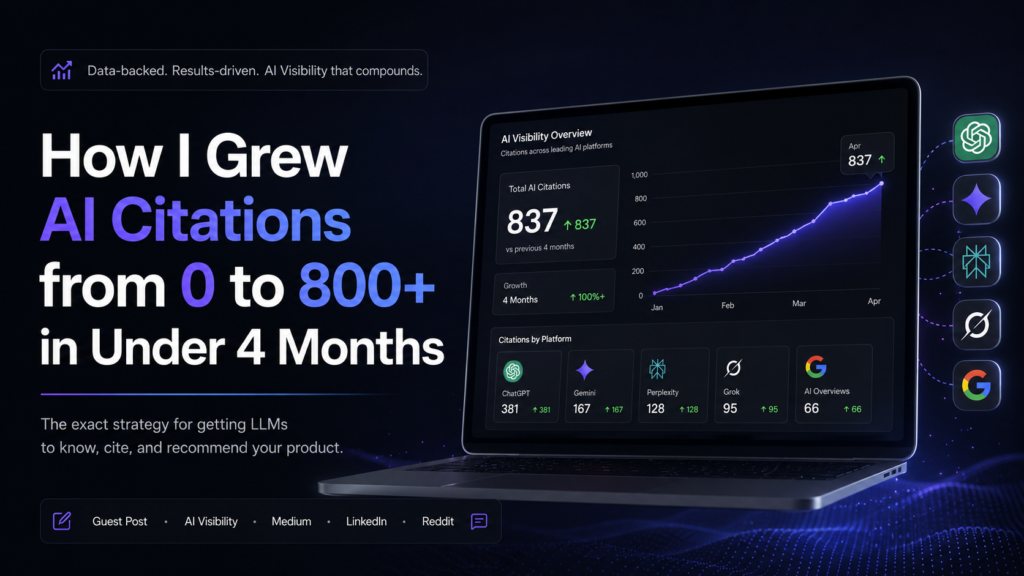
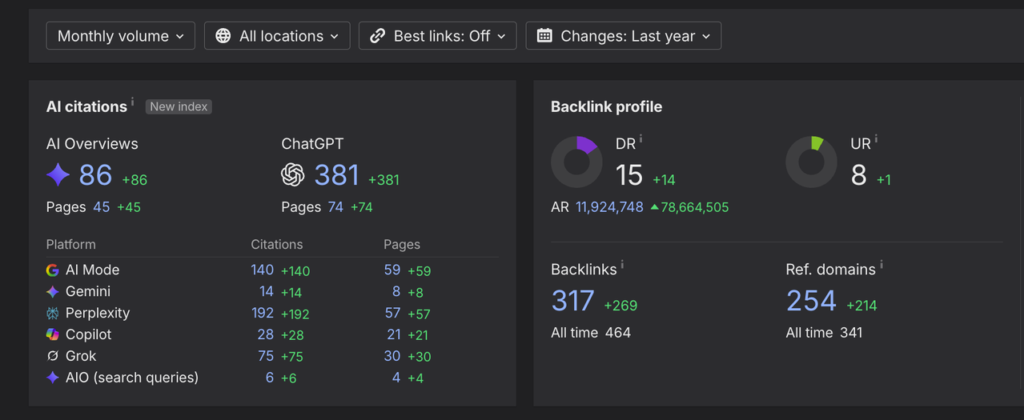
In one recent four-month campaign, an app went from effectively no measurable visibility across major AI platforms to more than 800 tracked citations and mentions. The campaign did not rely on a single viral post or a sudden wave of backlinks. Instead, it focused on creating useful third-party context around the product and distributing that context across multiple platforms.
The result offers a useful case study for founders and marketers trying to understand the emerging field of AI visibility.
What “AI visibility” actually means
The phrase can sound more mysterious than it is. In practice, AI visibility is about how often a brand, product or website appears in responses generated by AI assistants and AI-powered search experiences.
Those systems do not all work the same way. Some may use retrieval from the live web, some cite sources directly, and some synthesize information from multiple sources. That means no publisher or marketer can guarantee that one article will create one specific AI recommendation.
What can be measured, however, is whether a brand begins appearing more often across a defined set of prompts, whether third-party sources are being cited, and whether visibility is trending up or down over time.
The campaign in this case focused on that measurable trend rather than treating any single citation as proof of causation.
The strategy: build context, not just links
The central idea was simple: an unfamiliar product is easier for people — and potentially AI systems retrieving web information — to understand when it repeatedly appears in clear, relevant context.
Rather than publishing dozens of promotional posts, the campaign leaned heavily on content formats people already use when researching products:
• Comparison articles
• “Best tools” and “best apps” roundups
• Alternatives pages
• Frequently asked questions
• Problem-focused how-to articles
• Community discussions
A new product was usually positioned alongside established competitors rather than presented as an obvious No. 1 choice with no evidence. That made the content more useful to readers and gave the product a clear category association.
For example, a piece might compare several established tools and explain which option is best for different use cases. The new product could then be included where it genuinely fit.
Why FAQs and comparison content performed best
Of the content tested, question-led pages and comparison pieces appeared to produce the strongest citation rates.
The likely reason is practical. People tend to ask AI assistants direct questions such as “What is the best app for X?” or “What is a good alternative to Y?” A well-written article that directly answers the same question gives an AI-powered search system a structured source to retrieve and summarize.
Specific questions also tended to be more useful than broad ones. “Best CRM” is highly competitive and vague. “Best CRM for a three-person recruiting agency” gives both readers and AI systems far more context.
Roundups also worked better when they ended with a clear conclusion instead of simply listing products. A useful verdict might explain which product is best for freelancers, which is best for larger teams, and which is best for beginners.
Purely promotional posts, by comparison, produced little measurable impact.
The distribution numbers
Over roughly four months, the campaign distributed more than 190 pieces of content outside the main website. The mix included approximately:
• 50 Medium articles
• 100 LinkedIn posts
• 40 Facebook or community posts
• Additional Reddit and community mentions
The website itself also carried a foundation of deeper research-led articles.
The emphasis was not on copying the same post across 190 URLs. Each article had a separate angle, title or intent. A single category might be approached through competitor alternatives, beginner questions, pricing questions, industry-specific use cases or direct comparisons.
That variety mattered for a simple reason: repetitive content is not especially helpful to readers. A broader set of genuinely distinct articles creates more opportunities for a product to be described naturally in different contexts.
How the content was produced at scale
Producing nearly 200 pieces in a few months is difficult for a small team, so much of the execution was outsourced.
Writers were typically given a compact brief containing four elements:
1. A clear article title or question
2. The relevant product URL
3. Several legitimate competitors to research
4. A target length, usually around 800 to 1,200 words for full articles
The writers were not forced into a single template. Different voices, examples and structures were encouraged, provided the articles were original and factually accurate.
That approach helped avoid one of the biggest risks in scaled content campaigns: publishing dozens of slightly rewritten copies of the same page.
Where services fit into the process
Some companies will prefer to build this capability internally. Others may decide that writing, placement and community distribution are operational tasks worth outsourcing.
One example is LLMentioned, an AI-visibility service from 1stPage Agency that offers campaigns built around third-party mentions and content distribution, including LinkedIn, Medium and Reddit-focused activity.
Service link: https://www.1stpage.agency/llmentioned-ai-visibility/
The important point is that outsourcing distribution does not remove the need for strategy. A founder or marketing team still needs to define the category, audience, competitors, valid product claims and the questions real customers are asking.
Without that foundation, scaling content simply scales weak positioning.
Reddit and communities require a different standard
Community platforms can be valuable because they contain real questions, objections and product comparisons. They are also among the easiest places for brands to damage trust.
The sustainable approach is not to manufacture conversations or fake endorsements. It is to participate where the product or the team’s expertise genuinely adds value, follow community rules and disclose relevant affiliations.
A useful answer to a real question is far more durable than an obviously staged recommendation.
That distinction matters even more as publishers, users and AI systems become better at recognizing low-quality promotional patterns.
How the results were tracked
The campaign used AI visibility tracking software to monitor which platforms mentioned the product, which prompts triggered visibility, which sources were cited and how the trend changed over time.
The numbers were not stable from day to day. Citation counts rose, fell and sometimes recalibrated as AI systems changed their retrieval behavior and source selection.
That is why the campaign focused on longer-term direction rather than daily fluctuations.
A more useful measurement framework includes:
• Share of tracked prompts where the brand appears
• Which competitors appear more frequently
• Which third-party sources are cited
• AI referral traffic to the website
• Signups or conversions attributed to AI referrals where measurable
• Changes in visibility over several weeks or months
What this does and does not — prove
The campaign’s strongest lesson is not that publishing a specific number of Medium or LinkedIn posts guarantees 800 citations. It does not.
AI systems are opaque and constantly changing, and correlation should not be confused with proof that a particular article directly caused a particular answer.
What the experiment does suggest is that broader, useful and consistent third-party coverage can coincide with a meaningful increase in how often a product appears across AI-driven discovery channels.
It also reinforces a familiar marketing principle: credibility is stronger when other sources can independently explain what a product is, who it is for and how it compares with alternatives.
A practical five-step plan for a new product
For a company starting from zero, the campaign can be simplified into five phases.
Phase 1: Build the website foundation
Publish 10 to 15 substantial pages that clearly explain the product’s main use cases, customer questions, alternatives, comparisons and industry terminology.
Phase 2: Create third-party educational content
Develop a mix of FAQs, comparison articles, alternatives pages, roundups and problem-focused guides on suitable external platforms.
Phase 3: Build founder-led distribution
Use channels such as LinkedIn to publish useful observations, data and lessons from the category rather than repeating product advertisements.
Phase 4: Participate in real communities
Join relevant Reddit threads, forums and industry communities where the company can contribute expertise. Avoid manufactured engagement.
Phase 5: Measure from the beginning
Establish a baseline before distribution starts. Track AI mentions, prompt visibility, cited sources, referral traffic and conversions over time.
The bigger takeaway
Search engine optimization is not disappearing. Neither are backlinks, strong websites or traditional digital PR.
What is changing is the path people take to discover products.
A buyer may now move from a question directly to an AI-generated shortlist. For companies that are invisible in those answers, traditional search rankings may no longer tell the whole story.
The businesses most likely to benefit from this shift will probably be the ones that treat AI visibility as an extension of good publishing and good positioning: answer real questions, appear in credible contexts, make comparisons useful and give both people and machines enough consistent information to understand where the product belongs.
Publisher disclosure note: If the author or publisher has a commercial relationship with LLMentioned or 1stPage Agency, that relationship should be clearly disclosed before publication.