



The conversation about AI and jobs in 2026 has been overwhelmingly negative for job seekers. AI is replacing entry-level work. AI is screening resumes before humans see them. AI is generating mass-volume applications that drown out real candidates. AI is being used by recruiters to score, rank, and reject applicants based on patterns that often have nothing to do with whether someone could actually do the job.
For the average job seeker, AI has become something that happens to them rather than something that works for them.
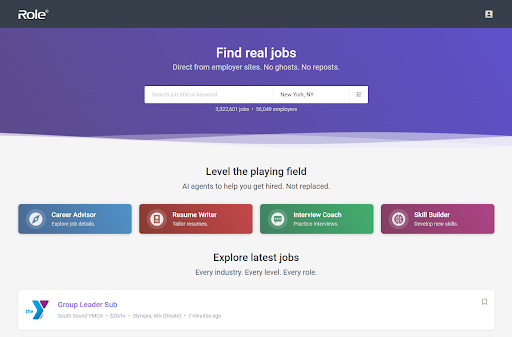
That’s the imbalance Role is trying to fix. The platform pulls 3.2 million real jobs directly from employer sites, but the more distinctive part of what Role offers may actually be its AI Career Agents. Four AI-powered tools designed around a single principle: AI should be helping job seekers compete in a market that AI itself has made harder.
The Problem AI Has Created for Job Seekers
To understand why Role’s approach matters, it helps to acknowledge what AI has done to the job search experience.
On the employer side, AI-powered Applicant Tracking Systems (ATS) now screen the majority of applications before any human sees them. Resumes that don’t match specific keyword patterns get filtered out automatically, regardless of whether the candidate is qualified. AI scoring tools rank candidates based on factors that often correlate poorly with actual job performance. And AI-generated job descriptions have become so formulaic that candidates struggle to figure out what employers actually want.
On the job seeker side, AI tools have flooded the application process with high-volume, low-quality applications. Some job postings now receive thousands of applications within hours, the majority of them AI-generated and indistinguishable from one another. Hiring managers, overwhelmed by this volume, respond by relying even more heavily on AI filtering, which creates a feedback loop that makes the entire process worse.
The net result is a job market where AI is being used aggressively against job seekers, while job seekers themselves often lack access to AI tools that would actually help them compete on equal footing.
The Four AI Career Agents
Role’s AI Career Agents are designed to flip that dynamic. Each one targets a specific friction point in the job search and applies AI to help the job seeker rather than the employer.
Career Advisor
The Career Advisor agent helps job seekers explore job details, understand what specific roles actually require, and figure out which opportunities are worth pursuing. It functions as an always-available career advisor that can break down job postings, compare opportunities, and surface insights that would otherwise require hours of independent research.
In a job market where postings are often vague and hiring managers use generic language to describe complex roles, having an AI that can parse a posting and explain what’s really being asked is genuinely valuable. The Career Advisor doesn’t just summarize. It contextualizes, helping job seekers make informed decisions about where to spend their application energy.
Resume Writer
The Resume Writer agent helps job seekers tailor resumes for specific roles. This isn’t a one-click resume generator that produces generic templates. It’s a tool designed to take the candidate’s actual experience and present it in a way that matches what a specific job is looking for, without misrepresenting qualifications.
The distinction matters. AI-generated resumes built from scratch often produce content that doesn’t reflect the candidate’s real background, which fails immediately in interviews. The Resume Writer agent starts with the candidate’s real experience and helps surface the parts that match each opportunity. The result is a tailored resume that gets through ATS filters while remaining honest about what the candidate actually brings.
Interview Coach
The Interview Coach agent helps job seekers practice interviews before they happen. Most job seekers know they should prepare for interviews, but the actual practice is hard to do alone. Reading interview prep articles doesn’t replicate the experience of being asked a behavioral question and having to respond in real time.
AI-powered interview practice fills that gap. The Interview Coach can simulate common interview questions for specific industries and roles, give feedback on responses, and help candidates refine how they tell their story before they’re in front of a real hiring manager. For first-time job seekers and career switchers especially, this kind of practice access can be transformative.
Skill Builder
The Skill Builder agent helps job seekers develop new skills as part of their career growth. The modern job market changes faster than most career paths can adapt. Skills that were valuable five years ago may be obsolete now, and skills that will matter in three years may not yet be widely taught.
The Skill Builder agent helps job seekers identify which skills are worth developing for their specific career goals and provides structured guidance on how to develop them. This is the long-term play in any job search, the recognition that finding a better job sometimes requires becoming a better-qualified candidate first.
Why This Combination Matters
Each of these four agents addresses a specific friction point, but the combination is what makes Role’s approach distinctive.
A job seeker using all four agents in coordination has access to something that previously required either significant money (hiring career coaches, resume writers, and interview consultants) or significant connections (mentors with industry insight, friends in HR, working professionals willing to do mock interviews). Both of those access paths favor candidates who are already privileged. The AI Career Agents democratize access to the kind of career support that used to be available only to the well-connected and well-resourced.
For first-generation professionals, career switchers, recent graduates, and anyone navigating a complex job market without strong network support, this is meaningful. The same AI that has been used against job seekers in screening processes is now being applied on the other side, to help candidates present themselves accurately and competitively.
What “Level the Playing Field” Actually Means
Role’s own framing for the AI Career Agents is direct: “AI agents to help you get hired. Not replaced.”
That tagline reflects a real philosophical position. Most AI in the hiring space has been built to reduce employer cost and effort, often at the expense of candidate experience. The candidates competing in this AI-heavy environment usually don’t have AI tools of their own, which creates an unfair asymmetry.
Role’s AI Career Agents are designed to correct that asymmetry. Job seekers using the platform have access to AI that works on their behalf throughout the entire job search journey. From understanding roles, to tailoring resumes, to preparing for interviews, to building skills for future opportunities, every stage gets AI-powered support.
This is the “level the playing field” idea in practice. Not eliminating AI from the hiring process, which isn’t realistic in 2026. But ensuring that job seekers have access to the same caliber of AI tools that employers have been using against them.
The Bigger Picture
Beyond the individual benefits to job seekers, Role’s AI-for-candidates approach represents a broader shift in how AI gets applied to the hiring process. For most of the past five years, AI in hiring has been almost exclusively a buyer-side technology, built for employers and recruiters. The candidate side of the equation has been treated as a population to be filtered, ranked, and managed rather than as users with their own legitimate needs.
That imbalance was always going to produce backlash, and Role is one of the first platforms to build seriously around the candidate side of the equation. The combination of real jobs (direct from employer sites) and AI Career Agents (built to help candidates compete) addresses both halves of what’s been broken.
For job seekers in 2026, that combination is more useful than either piece would be on its own.
The Bottom Line
The job search has gotten harder in the AI era, but the response doesn’t have to be passive. Job seekers now have access to AI tools that work on their behalf, applied at every stage of the process from initial role exploration to skill development for future roles.
Role’s four AI Career Agents (Career Advisor, Resume Writer, Interview Coach, and Skill Builder) put that capability in front of every job seeker on the platform, free to use, with no premium tier required to access the AI features. Combined with the 3.2 million real jobs from 55,000+ employers that Role indexes directly from career sites, the platform represents one of the more thoughtful attempts at fixing the job search experience available today.
The job market is going to keep changing. Job seekers who use the tools available to them have a meaningful advantage over those who don’t.
Try the AI Career Agents and search real jobs at role.com