



Sizing, materials, snow, pine needles, drainage, and the details that matter before installation

Quick answer
For many Spokane homes, seamless aluminum gutters are a practical starting point, but the right system depends on roof area, pitch, valleys, tree cover, and downspout discharge locations. A 5-inch K-style system may suit a typical roof, while larger or steeper roofs benefit from 6-inch gutters and larger downspouts. In the Inland Northwest, good installation also means planning for snowmelt, pine needles, freeze-thaw cycles, fascia condition, and drainage away from the foundation.
Why gutter choices matter more in Spokane than they first appear
Gutters are easy to forget when they work. Water leaves the roof, flows into a downspout, and the house looks unchanged. Problems usually appear only after overflow stains the siding, mulch washes away, fascia softens, or water repeatedly lands beside the foundation.
Spokane adds a few complications. The National Weather Service Spokane office tracks both precipitation and snowfall, so roof drainage must handle more than summer rain. The U.S. Department of Energy explains that ice-dam problems relate to roof temperature, insulation, ventilation, and air leakage. Gutters are not the whole winter-moisture system but sit exactly where roof runoff leaves the house.
That is why homeowners comparing Spokane gutters should look past color and curb appeal. The real questions are whether the system is sized for the roof, supported for local conditions, easy to maintain, and able to discharge water safely.
Seamless vs. sectional gutters: what is the practical difference?
Sectional gutters are assembled from shorter pieces. Seamless gutters are formed in long runs, usually on site, so straight sections have fewer joints. Corners, end caps, and downspout outlets still require connections, but reducing seams means fewer places where movement, sealant failure, or debris can cause leaks over time.
| Feature | Seamless gutters | Sectional gutters |
| Joints | Fewer along straight runs | More joints between sections |
| Fit | Formed to the roofline | Built from standard lengths |
| Installation | Usually professional | Can be DIY-friendly |
| Leak exposure | Fewer seam locations | More seam locations to maintain |
| Best fit | Long-term exterior project | Small repairs, sheds, or budget DIY work |
For a full-house replacement, seamless is usually the more sensible comparison point. The bigger decision then becomes size, material, style, and how the downspouts are laid out.
5-inch vs. 6-inch gutters: size the system to the roof
Five-inch K-style gutters are common on residential homes. Six-inch systems provide more capacity and are often considered when a roof has large planes, steep pitches, long valleys, or a few downspouts handling concentrated runoff. The downspouts matter too. Increasing gutter size without giving the water a clear outlet can simply move the bottleneck.
A good installer should evaluate roof area, pitch, valleys, outlet locations, and the distance water must travel inside each run. If one corner routinely overflows while the rest of the system behaves normally, that can be a layout or capacity problem rather than a cleaning problem.
Which gutter material makes sense in Spokane?
Material affects price, weight, appearance, corrosion, and fabrication. There is no universal “best” material, but three options cover most residential comparisons.
| Material | Why homeowners choose it | Main trade-off |
| Aluminum | Lightweight, corrosion-resistant, widely available, many colors | Can dent more easily than heavier metals |
| Steel | Strong and well suited to applications where durability matters | Heavier; coating and corrosion protection matter |
| Copper | Long service life and distinctive architectural finish | Substantially higher material and labor cost |
Aluminum is the default choice for many homes because it balances cost, durability, and maintenance. Steel may make sense when strength is a priority. Copper is usually an architectural decision as much as a drainage decision.
K-style, half-round, and box profiles
K-style gutters are the familiar residential profile on many modern homes. Half-round gutters have a traditional curved shape and are often chosen for appearance on historic or design-focused properties. Box-style gutters are larger and more architectural, common when capacity or roof design calls for them. The profile should follow the house and drainage needs, not a trend.
Spokane conditions that should change the installation plan
Snowmelt and freeze-thaw cycles
Snow on a roof does not behave like normal rain. Meltwater can arrive unevenly, refreeze near colder roof edges, and move again as temperatures change. Gutters do not prevent ice dams alone. Attic air sealing, insulation, ventilation, and roof temperature remain part of the problem. But once meltwater reaches the eave, the gutter and downspout system need a clear, supported path to move it away.
Some homes use heat cable or roof snow-retention products. These can be useful in specific situations but solve different problems. They should not replace correct gutter sizing, solid attachment, or fixing attic conditions that contribute to ice dams.
Pine needles and fine debris
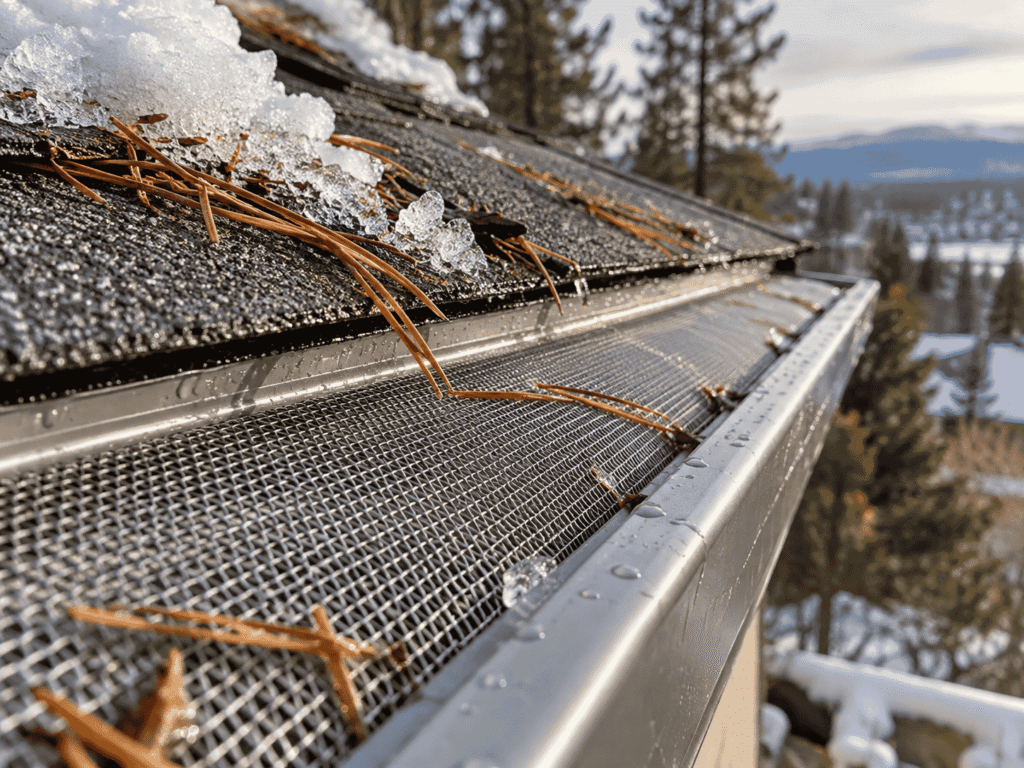
Broad leaves are not the only clogging problem around Spokane. Fine pine needles, seed material, and shingle grit can collect in outlets or work through coarse screens. That is why the phrase “gutter guard” is not enough. Homeowners should ask what type of debris the product is intended to handle and how it is cleaned when material accumulates on top.
Micro-mesh guards can be useful on heavily wooded lots because their openings are small, but no guard makes the system maintenance-free. Roof valleys and low-slope sections still need inspection after heavy debris events.
Downspouts and foundation drainage
Getting water into a downspout is only half the job. The U.S. Environmental Protection Agency describes foundation drainage as a system diverting water away from the structure. If a downspout empties beside the foundation, a new gutter can still leave the house with a water problem.
Look for erosion, washed-out mulch, splash marks, damp basement corners, or a downspout ending in a low spot. Extensions, underground drainage, or a different outlet location may matter as much as the gutter above.
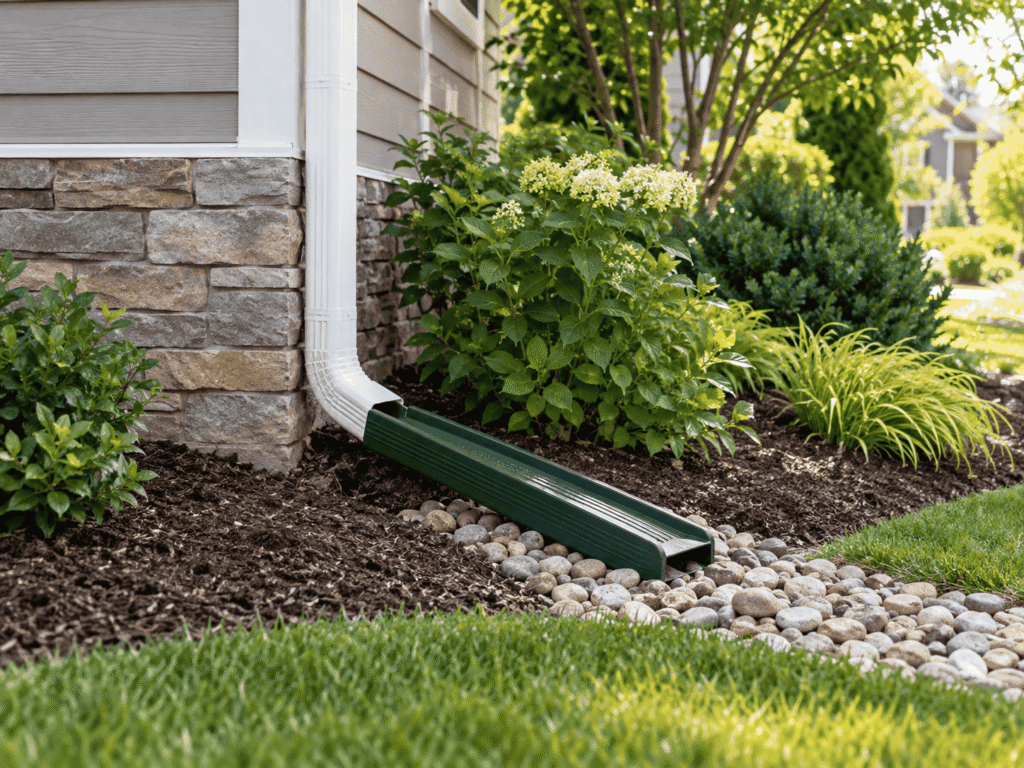
The downspout discharge point matters: roof water should be directed away from the structure rather than released beside the foundation.
What actually changes the cost of a gutter installation?
A price-per-foot number is only useful when two estimates describe the same job. Installation cost varies with the roof and scope. Before comparing bids, check what is included.
- linear footage and number of roof sections
- 5-inch vs. 6-inch gutters and downspout size
- aluminum, steel, or copper
- number of corners, valleys, and custom transitions
- one-story vs. two-story access and roof complexity
- removal and disposal of the old system
- fascia repair or replacement before installation
- gutter guards, specialty outlets, or drainage extensions
- custom colors or architectural profiles
- warranty coverage and post-installation service
This is why a very low bid is not automatically a bargain. It may exclude disposal, fascia work, larger outlets, guards, or other items that appear later as add-ons.
Repair or replace? Use the failure pattern, not the age alone
A single loose hanger or leaking corner does not justify replacing an otherwise sound system. Replacement is more reasonable when problems repeat across the house or the existing layout is wrong.
| Repair may be enough when… | Replacement makes more sense when… |
| one joint or end cap leaks | several runs leak or separate |
| one hanger has pulled loose | multiple sections sag or pull from the fascia |
| a downspout is damaged | outlets and downspouts are undersized for the roof |
| overflow is caused by an isolated clog | overflow keeps returning despite cleaning |
| the main runs are still straight and sound | fascia damage and drainage problems are widespread |
What professional installation should include
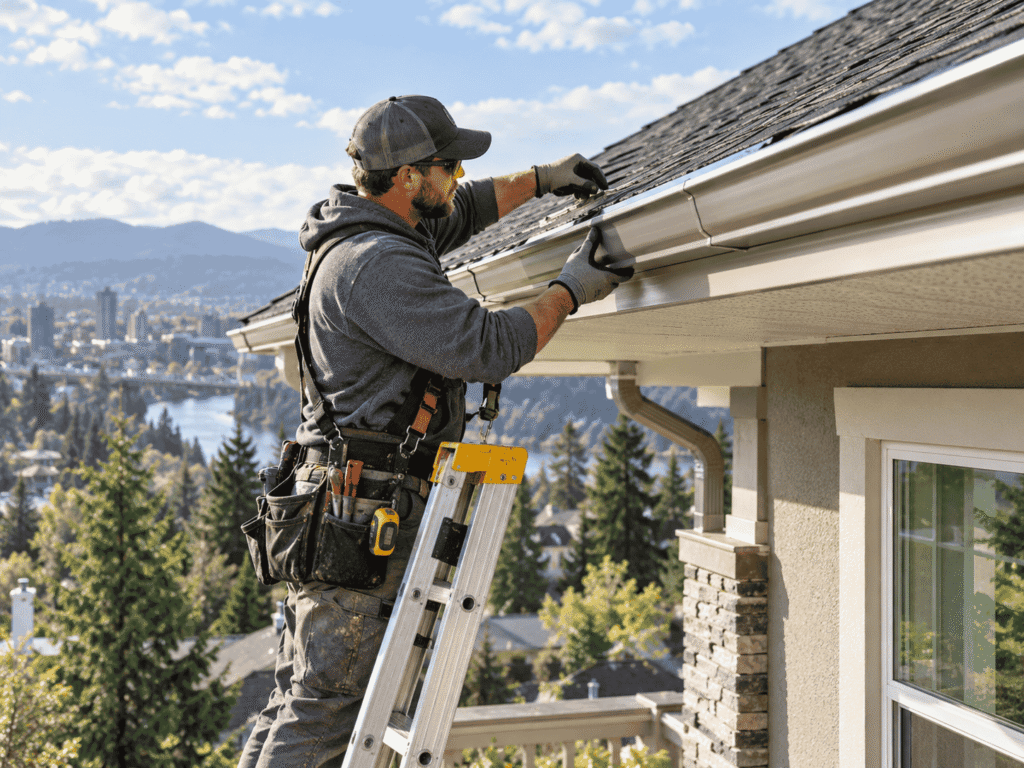
Professional Spokane gutter installation should begin with the roof and drainage plan, not a standard material package. A good quote should clearly state what is measured, installed, removed, repaired, and warranted.
- measure the roofline and identify valleys or runoff concentration points
- inspect fascia before covering it with a new system
- choose gutter and downspout size based on the roof, not habit
- form and fit the runs cleanly to the house
- use secure hanger spacing and a consistent drainage pitch
- seal corners, outlets, and end caps carefully
- confirm where every downspout discharges
- water-test problem areas and clean the site before completion
For a straightforward house, installation may be completed quickly. Complex rooflines, repairs, copper work, or drainage changes can add time. The useful question is not “Can you do it in a day?” but “What work is included in the schedule you are promising?”
How to choose a gutter contractor in Washington
Washington homeowners can use the Department of Labor & Industries contractor verification tool to check contractor registration, bond and insurance information, and other public records. L&I also recommends comparing written bids on scope, warranties, references, completion dates, and price rather than choosing on price alone.
Before accepting a bid, ask:
- Are you currently registered, bonded, and insured in Washington?
- What gutter size and material are you recommending for this roof, and why?
- Are the seamless runs formed on site?
- What hanger spacing and fastening method will you use?
- How will you handle roof valleys and concentrated runoff?
- What happens if you find damaged fascia after removal?
- Where will each downspout terminate?
- What workmanship warranty is included, and what is excluded?
- Are removal, haul-away, cleanup, and water testing included in the written price?
- What is the expected installation window for this specific house?
A short Spokane homeowner checklist
- Compare seamless vs. sectional gutters based on the whole-house project, not just material price.
- Ask whether the roof actually needs 5-inch or 6-inch gutters.
- Compare aluminum, steel, and copper on durability, appearance, and budget.
- If the property has pines, ask specifically how the guard handles needles and fine debris.
- Look at where water exits every downspout before approving the layout.
- Ask how snowmelt, roof valleys, and any recurring overflow spots affect the design.
- Check the written scope for fascia work, removal, cleanup, guards, extensions, and warranty.
- Verify the contractor through Washington L&I before work begins.
Frequently asked questions
Are seamless gutters better than sectional gutters?
For most full-house installations, seamless gutters have an advantage because long runs contain fewer joints and therefore fewer potential leak points. Sectional gutters can still make sense for smaller DIY projects or isolated repairs.
Are 6-inch gutters better than 5-inch gutters?
Not automatically. Six-inch gutters have more capacity, but a typical roof may perform well with 5-inch gutters when the outlets and downspouts are planned correctly. Larger roof areas, steep pitches, and heavy valley runoff are common reasons to consider 6-inch gutters.
What material is best for Spokane gutters?
Aluminum is the practical choice for many homes because it is lightweight, corrosion-resistant, and available in many colors. Steel offers more strength but requires attention to corrosion protection. Copper is durable and distinctive but costs considerably more.
How much does gutter installation cost in Spokane?
The final price depends on linear footage, gutter size, material, number of corners and downspouts, access, removal of old gutters, fascia repairs, guards, and drainage work. A useful estimate should itemize scope rather than rely on a single price-per-foot figure.
Are gutter guards worth it around pine trees?
They can reduce cleaning frequency, but design matters. Fine pine needles can pass through coarse screens or collect around outlets. Micro-mesh systems suit fine debris better but still require inspection and occasional maintenance.
Do gutters prevent ice dams?
No. Ice dams are influenced by attic heat loss, insulation, ventilation, and roof temperature. Gutters help manage water after it reaches the eave, but they do not correct the building conditions that create an ice dam.
When should gutters be replaced instead of repaired?
Replacement becomes more reasonable when multiple sections leak or sag, the system is undersized, overflow returns after cleaning, or the existing layout repeatedly sends water to the wrong places. An isolated leak or loose hanger can often be repaired.
What should I check before hiring a Spokane gutter installer?
Verify the contractor through Washington L&I, get a written scope, ask why a specific gutter size and material are being recommended, confirm the downspout plan, and understand the workmanship warranty and cleanup responsibilities.
The bottom line
The best gutter system for a Spokane home is not the one with the most add-ons. It is the one that matches the roof, handles local weather and debris, and carries water to a safe discharge point without creating new maintenance problems. Start with sizing and drainage, then choose the material, profile, guards, and cold-weather extras that solve a problem on that house. This approach produces a better installation than choosing by color, price per foot, or a generic package alone.