



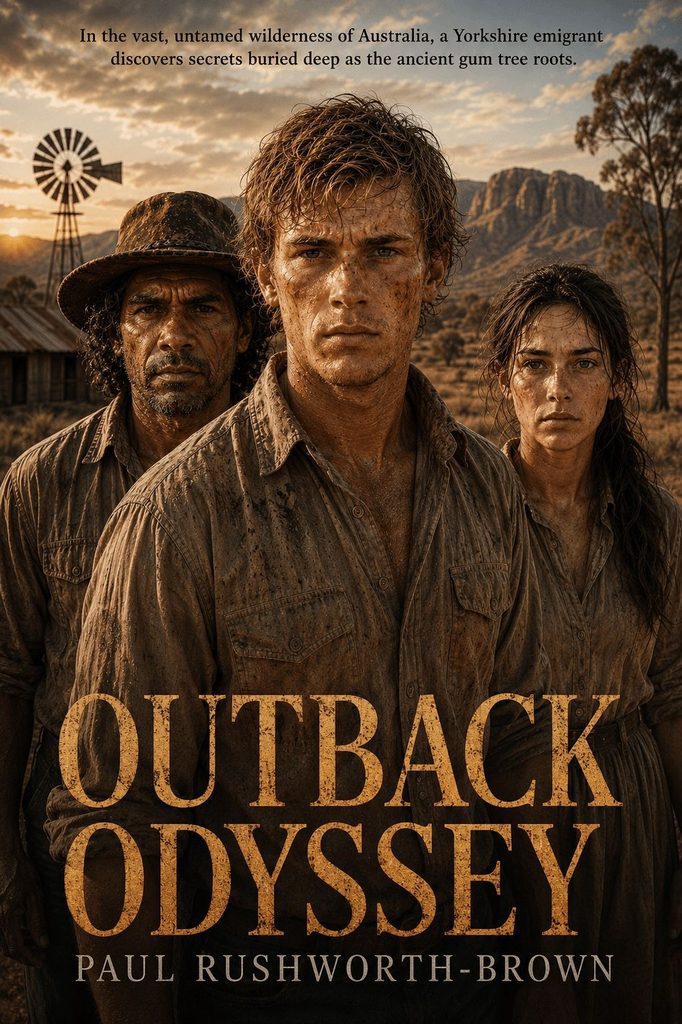
SYDNEY, AUSTRALIA – Long before Outback Odyssey garnered critical acclaim, international media attention, and interest from film producers, the narrative began with a personal family history. In the 1950s, a 17-year-old young man named Jimmy Brown boarded the passenger liner RMS Orion in Yorkshire, England, setting sail for Australia under the auspices of the Big Brother Movement. Like thousands of post-war British youths, he carried promises of prosperity, open horizons, and an unencumbered fresh start.
Instead, the reality he confronted upon arrival challenged every preconceived notion he held about his new home. Decades later, that personal journey provided the foundational spark for Outback Odyssey, the celebrated historical novel by his son, Australian author and educator Paul Rushworth-Brown.
The novel follows Jimmy from the green familiarity of Yorkshire to a remote sheep station, ultimately plunging him into an unforgiving outback terrain for which he is entirely unprepared. Initially perceiving the vast red landscape as an empty, hostile void to be conquered or survived, Jimmy undergoes a profound awakening through his encounters with First Nations Elder Jarrah and Aboriginal stockman Dhirrari. Through their guidance, the young migrant discovers that the land is far from empty; it is a living Country holding thousands of years of memory, wisdom, and deep cultural knowledge that he had never learned to see.
“Jimmy doesn’t tell Australia what to think,” said Rushworth-Brown. “He comes here believing he understands the country, and then experience forces him to question what he has been taught. In many ways, his journey asks Australia to look at itself.”
Moving well beyond traditional frontier adventure, Outback Odyssey weaves a human-interest exploration of migration, systemic prejudice, personal identity, and reconciliation in 1950s Australia. Jimmy is deliberately framed not as a faultless hero, but as a flawed young outsider whose internal moral compass requires recalibration. His personal evolution serves as an allegory for the migrant experience and prompts readers to examine how much of their understanding of other people is truth and how much is merely inherited bias.
The novel’s thematic resonance has earned broad international interest, drawing coverage across television, radio, and print outlets including the National Law Review, Rich Books Magazine, The Movie Boards, and NGAARDA Media. The book has also propelled Rushworth-Brown to a nomination for Author of the Year 2026 in the International Impact Book Awards. Cultural commentators have noted parallels to Harper Lee’s classic To Kill a Mockingbird, drawing comparisons not from setting or plot, but from shared themes of moral awakening, systemic prejudice, and the difficult courage required to dismantle inherited beliefs.
The narrative is poised to expand into visual media. A complete screenplay adaptation has entered the active screen development phase, with production teams engaging potential development partners. Rushworth-Brown emphasizes that while the RMS Orion voyage and the striking outback vistas provide cinematic scale, any screen adaptation will center strictly on the emotional core: Jimmy’s internal transformation, the depth of First Nations knowledge, and the realization that Country represents far more than mere scenery.
Beneath the literary distinctions and screen development remains the tribute to the teenager who crossed the globe seven decades ago. “Before the international coverage, before the award recognition, before the screenplay, there was simply a young Yorkshireman who crossed the world looking for a new life,” Rushworth-Brown reflected. “His name was Jimmy Brown. He was my father.”
Outback Odyssey is available worldwide via major book retailers and Amazon: https://www.amazon.com/Outback-Odyssey-Paul-Rushworth-Brown/dp/1964700140.
About Paul Rushworth-Brown
Paul Rushworth-Brown is an Australian historical fiction author and educator. His novels explore ordinary people living through periods of social and historical change, with particular attention to identity, belonging, and the human consequences of history. His work forms part of The Human Cost of History series.