



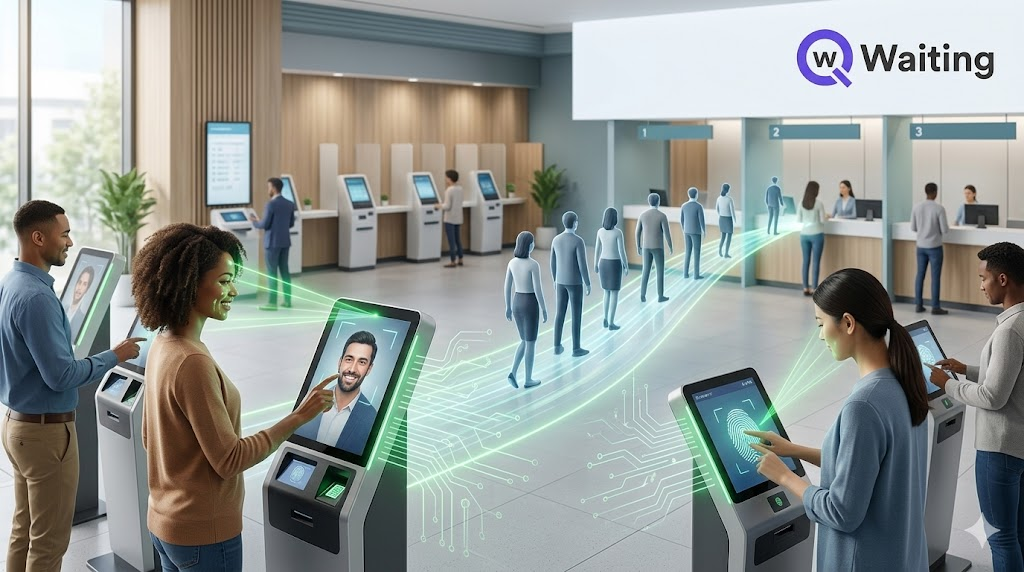
In this fast-paced digital world, people can easily unlock their phones, log into their bank accounts, and board their flights in seconds using the advanced biometric technology. However, still, in many businesses, visitors have to wait in long queues, fill out their details in a manual register as entry proof, and wait to be verified.
That gap is becoming expensive.
Time is crucial for everyone. Not just your customers, your staff members are also the ones who suffer equally in this. Long queues slow down operations, overwhelm staff, reduce service capacity, and damage brand perception. Poor customer flow is a major operational concern in sectors such as healthcare, banking, retail, and government services.
That is why businesses are investing in biometric queuing systems.
These systems are revolutionizing the way organizations process customer movement by eliminating manual logins and outdated ticket systems with quick, contactless identity verification.
In the following blog, let’s discover how the latest biometric queue technology reduces wait times and improves business management.
What Is a Biometric-Based Queuing System?
A biometric-based queuing system is a smart queue management solution that identifies and verifies customers using unique biological traits such as:
- Facial recognition
- Fingerprint scanning
- Iris recognition
- Palm recognition
No reception desk to check in, or a paper token is needed, as the customer can be recognized instantly by scanning a biometric. The system then automatically assigns them to the proper queue and directs them to the proper service point.
It speeds up the whole process, increases accuracy, and significantly reduces stress for employees and customers.
Consider the case of a patient who comes to the hospital for a follow-up visit.
In a conventional arrangement, the patient can be required to:
- Wait at the reception
- Share identification documents
- Confirm appointment details
- Fill out forms again
- Collect a queue ticket
With a biometric queue system, the patient simply scans their face at a self-service kiosk. Within seconds, the system identifies them, checks them in, and automatically directs them to the right department.
No paperwork. No repeated verification. No unnecessary delays.
That is the difference.
How Does a Biometric Queue System Work?
One reason businesses are rapidly adopting biometric queue management is that the experience feels simple for customers while delivering powerful automation behind the scenes.
Here’s how the process typically works.
1. Customer Arrives at the Location
The customer enters a branch, clinic, retail store, or government office and approaches a kiosk, tablet, or mobile check-in point.
Some businesses also allow pre-arrival verification through mobile apps.
2. Biometric Authentication Happens Instantly
The system scans the customer’s face, fingerprint, or other approved biometric identifier.
Within seconds, the software verifies the identity using encrypted records stored securely in the system.
This removes the need for:
- Manual identity checks
- Repeated form filling
- Physical documents
- Staff-assisted registration
3. The System Automatically Registers the Customer
Once verified, the customer is added to the correct queue automatically.
For example:
- A banking customer may be routed to mortgage services
- A hospital patient may be directed to diagnostics
- A government visitor may be sent to the passport renewal counters
The system eliminates unnecessary confusion and reduces routing errors.
4. Smart Queue Routing Begins
Modern biometric queue systems do far more than assign numbers.
They intelligently distribute visitors based on:
- Service type
- Staff availability
- Priority level
- Appointment status
- Customer history
This helps businesses avoid bottlenecks and improve service efficiency during peak hours.
5. Real-Time Notifications Keep Customers Updated
Customers receive updates through:
- SMS alerts
- WhatsApp notifications
- Mobile apps
- Digital signage displays
Instead of standing in crowded waiting areas, people can wait comfortably while staying informed about their queue status.
That small change dramatically improves customer perception.
The Biggest Benefits of Biometric-Based Queue Management
Businesses do not invest in biometric systems because they look modern.
They invest because the operational impact is measurable.
Here are the biggest advantages organizations are seeing.
1. Faster Customer Identification
Manual identity verification consumes an enormous amount of staff time every day.
Biometric systems remove that friction entirely.
Customers are recognized instantly, which:
- Speeds up onboarding
- Reduces registration workload
- Minimizes human error
- Increases daily service capacity
In high-volume environments, even saving one or two minutes per customer creates major operational gains.
2. Reduced Waiting Times
Long waits damage customer satisfaction faster than almost anything else.
Biometric queue systems reduce delays by automating:
- Check-ins
- Verification
- Queue assignment
- Customer routing
This creates smoother movement across the entire service journey.
Customers spend less time waiting and more time receiving actual service.
That difference matters.
3. Contactless Customer Experiences
Contactless interactions have become increasingly important across industries, especially in healthcare and public services.
Biometric queue systems reduce physical touchpoints by removing:
- Shared ticket dispensers
- Paper forms
- Manual registrations
- Physical identity handling
This creates a cleaner, safer, and more convenient experience for visitors.
It also helps organizations modernize their customer service environments without increasing staffing pressure.
4. Smarter Personalized Service
One major advantage of biometric technology is recognition continuity.
The system remembers returning visitors.
That allows businesses to create personalized service experiences such as:
- VIP queue prioritization
- Preferred language routing
- Repeat patient recognition
- Loyalty-based customer handling
- Faster returning visitor processing
Customers feel recognized instead of treated like strangers every time they visit.
That directly improves customer loyalty.
5. Better Operational Visibility
Traditional queue systems often leave managers guessing.
Biometric queue platforms provide real-time analytics into:
- Customer traffic
- Peak service hours
- Wait times
- Staff productivity
- Queue bottlenecks
- Service performance
This provides decision makers with greater visibility of areas of weakness and improvement within operations.
Rather than responding to complaints, companies can proactively manage customer traffic.
Common Concerns of Businesses regarding Biometric Queue Systems
Many organizations have been reluctant to embrace biometric technology despite the advantages.
There are typically three types of concerns.
“What About Privacy?”
This is the biggest question businesses ask.
Modern biometric queue platforms use:
- Encrypted data storage
- Permission-based authentication
- Compliance-driven security frameworks
- Controlled access systems
The focus is not surveillance.
The focus is on secure identity verification that improves operational efficiency while protecting customer information.
Organizations must still choose platforms that prioritize compliance and transparency.
That part matters greatly.
“Will Integration Be Complicated?”
Many modern queue management platforms are cloud-based and designed to integrate with:
- Appointment systems
- CRM platforms
- Hospital systems
- Banking software
- Visitor management tools
Deployment is often far simpler than businesses expect.
The best platforms reduce operational complexity instead of adding to it.
“Is It Worth the Investment?”
This question usually disappears once organizations calculate the operational cost of inefficient customer flow.
Long waits create:
- Lower customer satisfaction
- Reduced staff productivity
- Higher abandonment rates
- Increased operational pressure
- Negative brand perception
Businesses can use biometric queue management to offer improved service to their customers while also minimizing their resource usage.
It can make a big difference to your operating costs over the long-term.
The Future of Customer Flow is Identity-Driven.
Customers’ expectations will continue to rise.
This is what consumers want – a speedier, more convenient, and personalized service experience, and it applies to all.
For businesses, this will be difficult to achieve if they are using legacy queues.
Biometric-based queue management represents a major shift toward intelligent customer flow automation.
In the near future, organizations will move beyond basic queue management into:
- Predictive service optimization
- AI-powered visitor routing
- Hyper-personalized customer experiences
- Fully frictionless check-ins
The businesses leading customer experience transformation are already moving in that direction.
Final Thoughts
A biometric-based queuing system is not simply a faster way to manage lines.
It is a smarter way to manage customer experiences.
By combining secure identity verification with intelligent queue automation, businesses can:
- Reduce waiting times
- Improve operational efficiency
- Eliminate service friction
- Increase customer satisfaction
- Optimize staff performance
Most importantly, they create service experiences that feel modern, seamless, and customer-first.
Because in today’s business environment, customers do not compare your waiting experience to competitors alone.
They compare it to the fastest and smoothest experiences they have anywhere.
So the real question is:
Is your business still managing queues manually while customer expectations continue evolving?