

There is a particular kind of relief that comes with arriving at a hotel and realising you made the right choice. Not because anyone told you it was the right choice, or because a review assured you it would be. You just walk in, see the sea from the lobby, feel the temperature drop from the July pavement to the marble floor, and something in your shoulders loosens. Lordos Beach Hotel & Spa sits on the sandy shore of Larnaka Bay, and it produces that feeling within about ninety seconds of stepping through the door.
This is not a grand claim. It is a small, physical observation, and small physical observations tend to be the ones that actually determine whether a holiday works.
The geography of a good decision
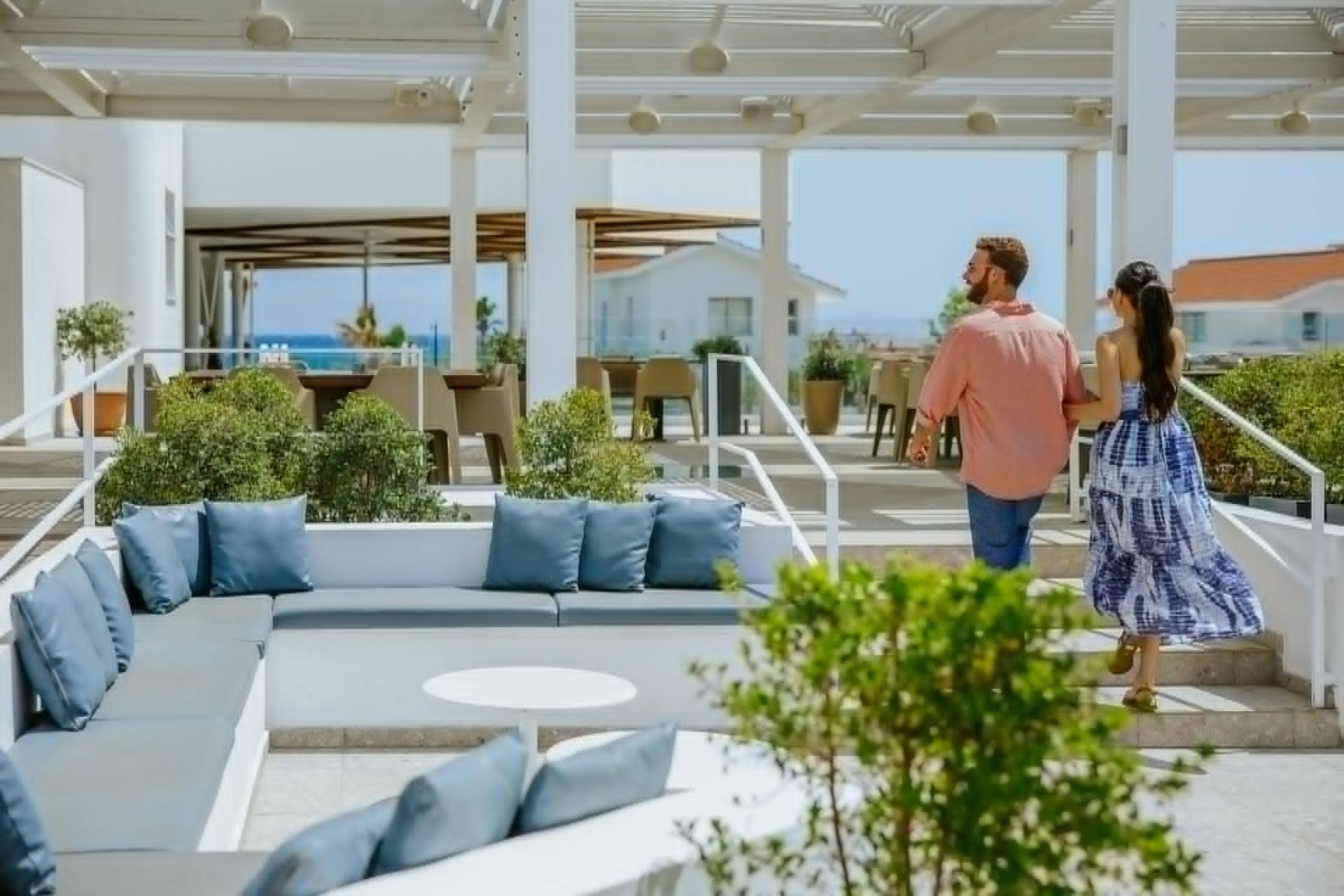
Location, in hotel terms, usually means distance from the airport or the nearest tourist strip. By those measures Lordos does well enough: 4km from Larnaka International, 5km from the city centre, close to both without being swallowed by either. But the more telling geography is what sits between the hotel and the water. The answer is: gardens, then pools, then sand. No road. No car park. No stretch of scrubby grass where a road used to be. The hotel’s cascading pools step down through landscaped terraces and deliver you, by eye if not by foot, directly to the Mediterranean.
That sightline changes the character of a stay. A room with a sea view is one thing. A property whose entire layout is oriented toward the water, so that breakfast, the pool, the bar, and the beach all face the same direction, is something else. Lordos was built along that axis, and it shows.
Rooms that solve problems quietly
A hotel room can be luxurious without being useful. Lordos skips the excess and focuses on the things that wear on you over a week when they’re wrong: temperature, space, noise, and a fridge you can actually put your own food in. Every room has air conditioning that works (a less universal guarantee in Cypriot four-stars than you might hope), a balcony, satellite TV, and a mini fridge that doubles as a personal fridge at no charge. That last detail is a small tell. Hotels that charge for fridge space are thinking about revenue. Hotels that let you stock the fridge yourself are thinking about what it’s like to be a guest.
Some rooms open onto private gardens with wooden decks rather than elevated balconies. These work particularly well for families with children who need ground-level outdoor space, or for anyone who finds a sixth-floor railing less relaxing than a chair on the grass. The room categories range from standard doubles to suites, and the sea is visible from most of them, because the building faces Larnaka Bay rather than presenting its shoulder to it.
Ether Spa, without the sales pitch
Spa descriptions tend to read like perfume adverts: a lot of language about journeys and sensory experiences, very little about what happens when you actually walk in. Here is what happens at Ether. You walk in. It is quiet. The recently renovated relaxation room has the kind of controlled stillness that suggests someone soundproofed it on purpose rather than by accident. There is an indoor pool, a sauna, a steam bath, and ice treatments for anyone whose definition of recovery includes a brief, voluntary shock to the system.
The therapists are on staff rather than contracted, which means you can book a session at short notice and ask for adjustments mid-treatment without navigating a third party’s scheduling system. Couples’ treatments are available. The spa operates as a functioning facility rather than a photogenic afterthought, and the difference between those two things is immediately apparent when you use it.
Four places to eat, none of them trying too hard
The Atlantis Restaurant handles daytime meals: a buffet breakfast with both full English and continental options, opening onto a covered patio beside the pool. The Oceanis Restaurant is the evening counterpart, fitted with mahogany panelling and brass fixtures that face the sea. Its menu rotates through international and Cypriot dishes on themed nights, and the room has the specific quality of feeling like a restaurant rather than a hotel dining room.
Between the pool and the beach, the Poseidon Pool Bar operates through the summer, preparing snacks and drinks to order so you can eat without leaving the water. The Sirens Bar covers evenings: cocktails, afternoon tea, a lounge atmosphere. Four distinct venues for a single property means you can eat at the hotel every night for a week without the creeping monotony that usually sets in by day three.
The city outside the gate
Larnaka rewards the curious. The Finikoudes promenade runs along the seafront, palm-lined and unhurried, ending at a medieval fort that looks out over the harbour. The Church of Saint Lazarus, supposedly built over the tomb of the biblical Lazarus himself, is a ten-minute drive. The Kamares Aqueduct, an Ottoman structure with 33 arches, stands inland and is usually yours alone.
The salt lake west of the airport fills with water in winter and draws greater flamingos by the thousand. In summer it dries to a white crust that shimmers in the heat. The Hala Sultan Tekke mosque, one of the most important Islamic pilgrimage sites in the Eastern Mediterranean, sits at the lake’s edge. And offshore, the Zenobia, a Swedish ferry that sank on its maiden voyage in 1980, lies at 16 to 42 metres and has been on every serious diver’s shortlist for decades.
None of this requires a tour guide or an itinerary. You rent a car at the airport, park it at Lordos, and follow your own curiosity. The hotel keeps cycling routes mapped for guests who prefer the coastline on two wheels, and the watersports operation on the beach can put you on a windsurf board, a jet ski, or a sailboat without leaving the property.
What a week here actually feels like
A good hotel anchors a trip the way a good sentence anchors a paragraph: you barely notice the structure, but everything around it makes more sense because of it. Lordos handles the mechanics of a holiday so cleanly that what you remember afterwards is not the hotel itself but what the hotel made possible. The morning you swam before breakfast and the water was flat as glass. The afternoon you spent at Choirokoitia, the 9,000-year-old Neolithic settlement twenty minutes up the motorway, and came back to find a cold drink waiting at the Poseidon bar. The evening the Oceanis kitchen ran a Cypriot meze night and you ate until continuing felt unreasonable.
These are not hotel features. They are the texture of a week in which nothing went wrong, and everything landed roughly where it should. That is harder to engineer than it sounds, and it is what Lordos, without calling attention to itself, consistently gets right.